
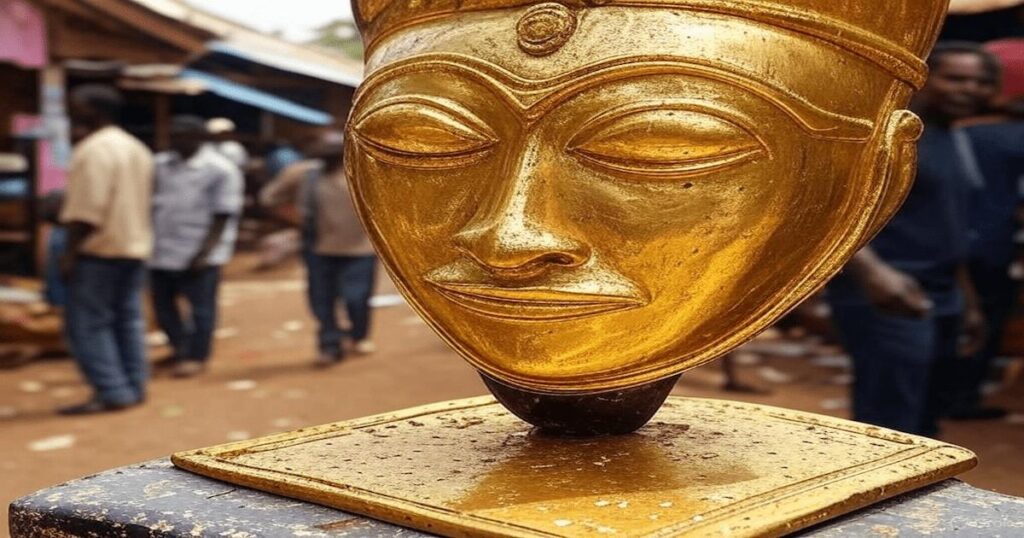
In the heart of Africa, where the sun kisses the earth with a fiery glow, gold has long been more than a metal, It’s a story, a dream, a pulse of power and prestige. From the ancient kingdoms of the Sahel to the bustling ports of the Swahili Coast, the gold trade wove a glittering tapestry across the continent, connecting distant lands and shaping civilisations.
For those new to Africa’s past, this is not just a tale of commerce but a saga of ambition, ingenuity, and resilience that spanned over two millennia, from roughly 1000 BCE to the 19th century CE. Let us embark on a journey through time, tracing the rise, zenith, and transformation of Africa’s gold trade, with a storyteller’s heart to captivate and enchant.
The Dawn of Gold: Ancient Beginnings
Gold, that radiant symbol of wealth, has sparkled in Africa’s story since time immemorial. The continent’s geological bounty, rich with gold deposits, lay scattered across its landscapes, from the highlands of Zimbabwe to the riverbeds of West Africa.
As early as 1000 BCE, African communities were mining this treasure, not with industrial machines but with skillful hands, using pans, picks, and communal labor. Gold was revered, not just for its lustre but for its spiritual weight, often associated with divine favour and royal authority.
In ancient Nubia, along the Nile in modern-day Sudan, the Kingdom of Kush (c. 1070 BCE–350 CE) was among the first to harness gold’s power. The Kushites, master traders and artisans, extracted gold from the Nubian Desert, crafting it into jewellery and offerings for their gods.
Their gold flowed north to Egypt, adorning pharaohs’ tombs and temples. Imagine the sight: Nubian caravans, laden with shimmering nuggets, crossing the desert under starlit skies, their wealth fuelling an empire that rivalled Egypt’s grandeur.
Yet, it was in West Africa, centuries later, that the precious metal trade truly blossomed. The region’s savannas and forests, crisscrossed by rivers like the Niger and Senegal, hid vast goldfields.
By the 4th century CE, local communities in modern-day Ghana, Mali, and Senegal were mining gold, trading it with neighbours, and forging connections that would reshape the world. This was the seed of Africa’s golden age, a time when empires would rise on the strength of this precious metal.
The Rise of Empires: Ghana and the Trans-Saharan Trade
The precious metal trade’s first great chapter unfolded in West Africa with the rise of the Ghana Empire (c. 300–1200 CE). Centred in what is now south-eastern Mauritania and western Mali, Ghana was a land of legend, its capital, Kumbi Saleh, a bustling hub of commerce.
The empire’s wealth stemmed from its control of goldfields in the Bambuk and Bure regions, where miners, often women, sifted rivers for alluvial gold. This wasn’t just labor, it was an art, a communal dance of skill and tradition.
Ghana’s genius lay in its mastery of the trans-Saharan trade. By the 8th century CE, Arab and Berber traders, riding camels across the Sahara’s dunes, linked West Africa to North Africa and beyond.
The precious metal was the star of this trade, carried north in camel caravans alongside ivory, salt, and slaves. In return, Ghana received horses, textiles, and knowledge, Islamic scholarship, writing, and architecture. The empire’s kings, known as the Wagadu, taxed this trade, amassing wealth so vast that Arab chroniclers like Al-Bakri marvelled at their courts, where precious metal adorned everything from sceptres to horse bridles.
Picture the scene: a Ghanaian king, resplendent in gold-embroidered robes, presiding over a market where merchants haggled in a dozen tongues. The air hums with the clink of precious metal nuggets, the scent of spices, and the rhythm of griots singing royal praises.
Ghana’s precious metal didn’t just enrich its rulers; it fuelled a cultural renaissance, blending African traditions with Islamic influences. Mosques rose alongside ancestral shrines, and Timbuktu, though not yet famous, began its ascent as a scholarly beacon.
The Golden Zenith: Mali and Songhai
Ghana’s fall around 1200 CE, weakened by invasions and drought, only set the stage for a greater empire: Mali (c. 1230–1600 CE). Mali was the gold trade’s crescendo, a kingdom whose name still evokes awe.
Founded by Sundiata Keita, a warrior-king of mythic stature, Mali stretched from the Atlantic to the Niger River, encompassing goldfields in Bambuk, Bure, and Akan. Its capital, Niani, was a cosmopolitan crossroads, but it was Timbuktu that became the world’s precious metal standard for learning and wealth.
Mali’s precious metal trade was a marvel of organisation. Miners, traders, and royal officials worked in harmony, with the Mansa (king) overseeing the flow of precious metal. The Akan goldfields, in modern-day Ghana, became a major source, with their forest communities supplying gold to Mali’s markets.
Caravans, sometimes thousands of camels strong, carried gold north to cities like Sijilmasa and Tunis, where it entered the Mediterranean and Middle Eastern economies. By the 14th century, Mali’s precious metal underpinned global trade, stabilising currencies from Cairo to Cordoba.
The most iconic moment came in 1324, when Mansa Musa, Mali’s greatest ruler, embarked on a pilgrimage to Mecca. His caravan, laden with 18 tons of precious metal, dazzled the Islamic world.
In Cairo, Musa’s generosity, handing out precious metal to scholars, merchants, and the poor, caused inflation that lingered for years. His journey wasn’t just a display of wealth but a diplomatic masterstroke, putting Mali on the world map. European cartographers, awed by tales of a golden king, began depicting Mali on maps like the Catalan Atlas, with Musa holding a gold nugget.
Mali’s precious metal fuelled a cultural golden age. Timbuktu’s Sankore University drew scholars from across the Islamic world, its libraries brimming with manuscripts on astronomy, law, and poetry.
Griots, the oral historians, wove tales of Mali’s glory, their voices echoing in mud-brick mosques. Precious metal wasn’t just currency; it was the lifeblood of a civilisation that married wealth with wisdom.
By the 15th century, the Songhai Empire (c. 1464–1591 CE) inherited Mali’s mantle. Centred in Gao, Songhai expanded the precious metal trade, controlling the same trans-Saharan routes. Askia Muhammad, its greatest ruler, streamlined trade and pilgrimage routes, ensuring precious metal flowed smoothly to North Africa.
Songhai’s markets glittered with gold dust, weighed on delicate scales, as traders from Venice and Constantinople vied for a share. Yet, Songhai’s reliance on precious metals made it vulnerable. When Moroccan invaders, armed with gunpowder, sacked Gao in 1591, the empire crumbled, signalling the end of West Africa’s golden empires.
The East African Gold Trade: Great Zimbabwe and the Swahili Coast
While West Africa’s precious metal dazzled the Sahara, East Africa’s precious metal trade sparkled along the Indian Ocean. The Kingdom of Great Zimbabwe (c. 1100–1450 CE), in modern-day Zimbabwe and southern Mozambique, was a powerhouse built on precious metal.
Its goldfields, nestled in the Zambezi and Limpopo valleys, supplied the Swahili Coast’s ports, Kilwa, Sofala, and Mombasa, where African, Arab, and Indian traders met.
Great Zimbabwe was a marvel of engineering, its stone palaces, like the Great Enclosure, built without mortar. Precious metal was mined by local Shona communities, smelted into ingots, and traded for Chinese porcelain, Persian glass, and Indian textiles.
Kilwa, described by traveller Ibn Battuta as “one of the finest cities,” was the hub of this trade, its sultans amassing fortunes. By the 13th century, East African gold reached as far as China and India, carried by monsoon-driven dhows.
Imagine the Swahili Coast: coral-stone mosques gleaming against turquoise waters, merchants bartering gold for silk under palm-fringed skies. This was a cosmopolitan world where African ingenuity met global ambition.
Great Zimbabwe’s decline, likely due to environmental strain, didn’t dim the coast’s lustre. Ports like Mombasa thrived into the 16th century, until Portuguese colonisers disrupted the trade, redirecting gold to Europe.
The Twilight and Transformation: Colonial Shadows
By the 16th century, Africa’s gold trade faced new challenges. European powers, Portuguese, Dutch, and British, sought to control the continent’s wealth. In West Africa, the Akan states, like Asante (c. 1701–1901), rose to prominence, their goldfields fuelling a powerful empire.
Asante’s kings, adorned in gold regalia, resisted European encroachment, but the Atlantic slave trade, peaking in the 17th–19th centuries, shifted focus from gold to human cargo. Gold still flowed, but its prominence waned as colonial powers plundered Africa’s resources.
The 19th century brought industrial mining, with Europeans exploiting South Africa’s Witwatersrand goldfields, discovered in 1886.
Traditional African mining, once a communal art, was overshadowed by colonial enterprises. Yet, Africa’s gold trade never truly ended; it transformed, feeding global markets while leaving a legacy of resilience.
Africa’s Gold
Africa’s gold trade is a saga of human spirit, a thread that stitched empires to the world. From Kush’s desert caravans to Mali’s scholarly cities, Great Zimbabwe’s stone palaces, and Kilwa’s coral ports, gold was more than wealth; it was a catalyst for culture, connection, and creativity.
For those new to Africa, this story dispels myths of a “dark continent,” revealing a land of light, where gold illuminated paths to greatness.
Stand on the banks of the Niger, where miners still pan for gold, or gaze at Great Zimbabwe’s ruins, where stones whisper of ancient wealth.
Feel the pulse of Timbuktu, where manuscripts preserve a golden age. Africa’s gold trade is not just history, it’s a legacy reminder that this continent, with its radiant heart, has always shaped the world’s dreams.