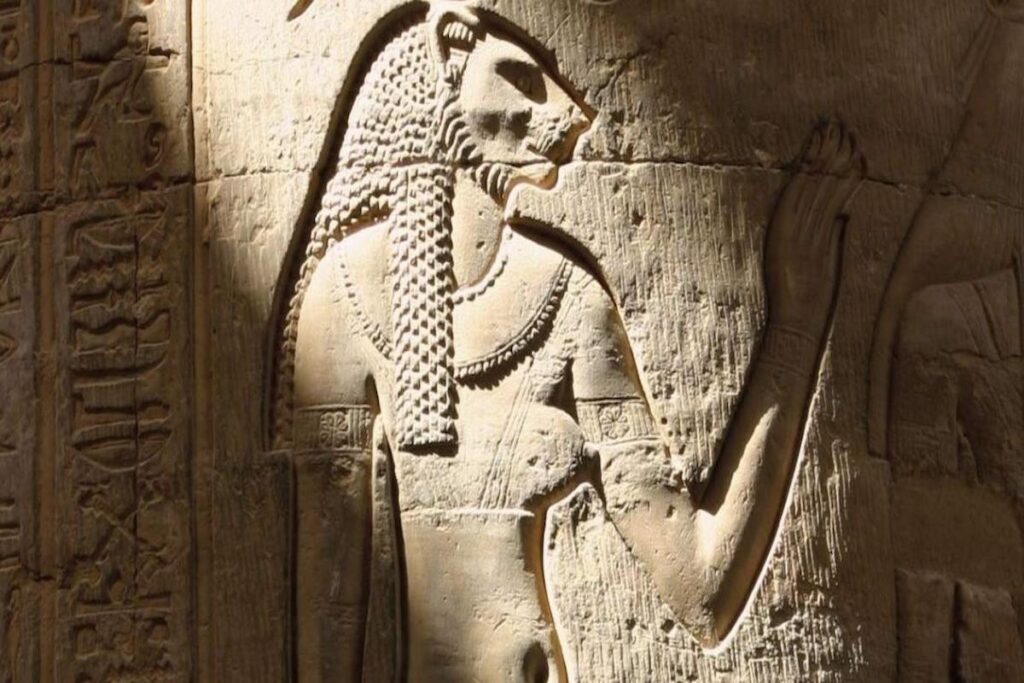
The Lioness’s Fury: Sekhmet and the Red Flood

Sekhmet

In the golden dawn of Egypt’s Old Kingdom, when pyramids rose like stairways to the gods, the Nile whispered secrets of a world held in delicate balance. This was a land of Ma’at, order, truth, and harmony, watched over by Ra, the sun god whose radiant gaze warmed the earth. But beneath the sun’s glow, a storm brewed, born of human folly and divine wrath.
This is the tale of Sekhmet, the lioness goddess whose fury nearly drowned mankind in blood, and of Ra’s desperate plan to save his creation with a flood of crimson beer. It’s a story of chaos and renewal, of a goddess torn between destruction and love, and of a cosmos striving for balance.

Ra’s Gaze and Humanity’s Fall

Ra, the falcon-headed sun god, sailed daily across the sky in his solar barque, his sun disk a beacon of life. From his celestial throne, he watched humanity, his children, whom he had crafted from the primordial waters of Nun. In the Old Kingdom, when pharaohs built monuments to eternity, Ra expected gratitude and adherence to Ma’at. But mankind grew reckless, scheming, warring, and defying the sacred order.

Their greed and pride disrupted the cosmic harmony, like stones rippling the Nile’s calm surface. Ra’s heart, once warm, grew heavy with disappointment. Humanity’s rebellion was a wound to Ma’at, and the sun god resolved to punish them, his decision both a father’s discipline and a king’s decree.

Sekhmet: The Lioness Unleashed

To enact his judgment, Ra summoned Sekhmet, a goddess born from his own fiery will. Sekhmet was the Eye of Ra, an extension of his power, her name meaning “the powerful one.” With a lioness’s head, eyes blazing like embers, and a body draped in red, she was divine wrath incarnate, yet also held a duality, fierce destroyer and fierce protector.

Linked to Hathor, the gentle goddess of love and joy, Sekhmet was Hathor’s shadow, her rage a twisted mirror of Hathor’s nurturing warmth. This inner conflict, love and destruction entwined, made Sekhmet a force of awe and terror. Ra sent her to earth, her roar shaking the sands, to punish mankind for their sins against Ma’at.

The Bloodlust and Chaos Unleashed

Sekhmet descended like a wildfire, her claws tearing through villages, her breath a scorching wind. Her bloodlust was insatiable, a primal hunger that drove her to slaughter without mercy. Fields turned crimson, the Nile choked with the fallen, and humanity’s cries rose to the heavens. The world spiraled into chaos, Ma’at’s delicate balance shattered as Sekhmet’s rampage spared neither the guilty nor the innocent.

Temples crumbled, crops withered, and the land groaned under the weight of destruction. Mankind, once proud, now cowered, their rebellion replaced by despair. Yet within Sekhmet’s fury lay a mystery, a goddess torn between her divine duty and the Hathor-like love buried deep within her, a duality reflecting the human struggle between creation and ruin.

Ra’s Regret and the Divine Council

High above, Ra watched, his heart twisting with regret. He had sought justice, not annihilation. Humanity, flawed as they were, was still his creation, and their near-destruction threatened the very cosmology he upheld, a world born from order, not chaos.

Ra called a council of gods, their voices echoing in the celestial realm. Thoth, the ibis-headed god of wisdom, urged a solution that honoured Ma’at’s balance. Hathor, her eyes soft with compassion, reminded Ra of her connection to Sekhmet, hinting at the lioness’s hidden potential for renewal. Ra devised a plan, a delicate deception born of sacrifice and cunning, to halt Sekhmet’s rampage without breaking her divine spirit.

The Crimson Flood: A Brew of Deception

Ra’s strategy was as bold as it was tender, a trick to soothe the lioness’s fury. He ordered the gods to gather vats of beer, thousands of jugs brewed from barley in the temples of Heliopolis. To mimic blood, they mixed in red ochre, a sacred pigment from the earth, its hue rich with the symbolism of life and sacrifice. Under Ra’s command, the gods poured the crimson brew into the fields near Dendera, Sekhmet’s hunting ground, creating a vast, shimmering flood that gleamed like a sea of blood under the dawn. The red ochre, tied to rituals of offering, was a silent prayer for Ma’at’s restoration, a sacrifice to appease the divine wrath.

As the sun rose, Sekhmet bounded into the fields, her eyes alight with bloodlust. Seeing the crimson flood, she mistook it for the blood of her prey. With a triumphant roar, she drank deeply, gulping the beer until her senses swam. The alcohol dulled her rage, her limbs grew heavy, and her roars softened to murmurs. The deception worked, Sekhmet’s bloodlust faded, and she sank into a drunken slumber, her destructive fire quenched. The gods watched in awe, their hearts lifted by Ra’s wisdom and the power of their collective intervention.

Transformation: From Fury to Renewal

As Sekhmet slept, a miracle unfolded. The goddess awoke not as the lioness of wrath but transformed, her spirit softened, her Hathor-like essence rising to the surface. The duality within her, destroyer and nurturer, found harmony, reflecting the divine capacity for both judgment and mercy. Hathor’s gentle presence shimmered in Sekhmet’s eyes, a reminder that love could tame even the fiercest storm.

The land, scarred by her rampage, began to heal, as the surviving humans emerged, humbled and repentant. Ra, his sun disk glowing warmly, declared Ma’at restored, the balance between order and chaos renewed. Sekhmet, now a guardian as much as a warrior, stood as a symbol of transformation, her story a lesson in the potential for redemption within gods and mortals alike.

Humanity’s Plight and the Cosmos Restored

The myth of Sekhmet was more than a tale of divine anger, it was a cornerstone of ancient Egyptian cosmology, reflecting beliefs about creation, the gods’ roles, and existence’s fragile balance. In the Old Kingdom, when the myth likely took shape, Egyptians saw humanity’s role as upholding Ma’at through devotion and harmony. Their rebellion, greed, strife, defiance, had invited chaos, but Sekhmet’s rampage showed the consequences of disrupting the divine order. The flood of beer, a sacred offering, was a sacrifice to restore what was broken, echoing rituals where offerings appeased the gods.

The story’s significance lay in its message: the gods, like humans, held duality. wrath and mercy, destruction and creation. Sekhmet’s transformation mirrored humanity’s chance to learn from their mistakes, to rebuild with humility. The red ochre in the beer, used in temple rites, tied the myth to Egypt’s spiritual life, symbolising life’s renewal through sacrifice. The cosmos, shaken by chaos, found equilibrium, affirming Ra’s role as the guardian of Ma’at and the gods’ duty to guide, not destroy, their creation.

The Myth’s Eternal Echoes

In the temples of Dendera and Memphis, priests chanted Sekhmet’s tale, her statues both feared and revered. The myth, preserved in texts like the Book of the Heavenly Cow, was a warning and a promise: stray from Ma’at, and chaos follows; seek balance, and renewal awaits. Sekhmet’s duality inspired rituals where beer and ochre offerings honoured her, ensuring her protection rather than her wrath. The story shaped Egyptian views of the divine-human condition, showing that even gods wrestle with conflicting natures, just as humans grapple with pride and redemption.

Today, Sekhmet’s roar echoes in museum halls and storybooks, her tale a vibrant thread in Egypt’s mythological tapestry. It reminds us of the delicate dance between order and chaos, the power of sacrifice to heal, and the hope that even the fiercest storms can give way to dawn. As the Nile flows on, Sekhmet stands watch, her lioness heart a testament to the eternal quest for balance.
The Eternal Dance of Osiris: A Tale of Life, Death, and Rebirth

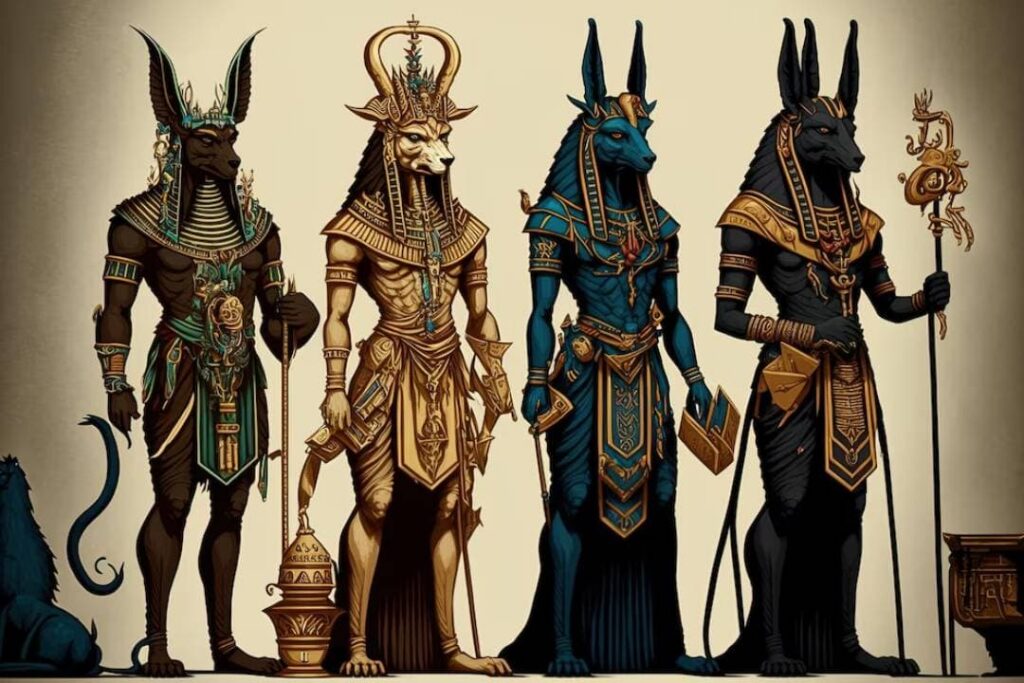
egyptian-deities-including-anubis-seth-hathor-horus_

Step into ancient Egypt, where the Nile’s gentle ripples reflect a sky ablaze with stars, and the gods walk among whispers of papyrus and stone. Here, in a time before pyramids touched the heavens, a story unfolded that would echo through millennia, the Osirian Cycle, a saga of love, betrayal, and triumph that shaped the heart of a civilization.

This is no mere myth but a sacred truth to the Egyptians, carved in temple walls and chanted in the Pyramid Texts, revealing the mysteries of Osiris, Isis, Horus, Seth, and Nephthys. Let’s journey to their world, where life and death dance in an eternal embrace, and secrets of the gods unfold like lotus petals at dawn.

The Golden King and His Verdant Realm

In the beginning, when the world was young, Osiris stood as Egypt’s first king, a god of radiant wisdom and boundless generosity. His skin shimmered green, like the fertile fields he blessed, and his eyes held the promise of life itself. Osiris taught humanity to sow grain, brew beer, and live in harmony, turning chaos into order.

By his side was Isis, his sister and queen, her beauty matched only by her magic, which could weave spells to mend or protect. Together, they ruled a golden age, their love as steady as the Nile’s flow. But every light casts a shadow. Seth, Osiris’s brother, burned with envy, his heart a storm of chaos. A god of deserts and tempests, Seth’s red hair and fierce eyes marked him as wild, untamed.

Nephthys, Seth’s wife and another sister, watched quietly, her loyalty torn between her husband and her love for Osiris and Isis. These four, bound by blood and fate, were the pillars of a story that would test the very fabric of the cosmos.

A Treacherous Feast and a Secret Plot

The Osirian Cycle’s first mystery unfolds in a moment of betrayal, cloaked in celebration. Seth, consumed by jealousy, devised a plan as cunning as the desert fox. He invited Osiris to a grand feast, where laughter rang and wine flowed like the river. Amid the revelry, Seth unveiled a magnificent chest, carved with spells and inlaid with gold, promising it to whoever fit perfectly inside. The guests tried, one by one, but none knew the chest was crafted to Osiris’s exact measure a secret only Seth held.

Osiris, trusting and noble, lay within the chest, his laughter echoing as the lid slammed shut. In an instant, Seth’s followers sealed it with molten lead, and the chest became a tomb. The guests gasped, but Seth’s triumph was swift. He hurled the chest into the Nile, where it drifted away, carrying Osiris to a watery fate. The mystery deepened: where had Osiris gone, and could life endure without its king?

Isis’s Quest: A Mother’s Magic

Isis, heartbroken yet fierce, refused to let her love vanish. She was no ordinary goddess, her magic was a river of power, her heart a beacon of hope. With Nephthys by her side, weeping for her brother’s fate, Isis scoured the land, her wings of a kite soaring over reeds and marshes.

Nephthys, often silent in the myth, played a tender role, her loyalty to Isis a quiet secret that softened the cycle’s tragedy. Together, they followed whispers of the chest, which had washed ashore in Byblos, entwined in a tamarisk tree that grew into a pillar for a king’s palace.

Using her cunning, Isis entered the palace as a nursemaid, her magic unrecognized. She retrieved the chest, cradling it as tears fell, and brought it back to Egypt’s marshes to hide. Here, another secret unfolded: Isis’s spells could defy death itself.

Alone under the stars, she chanted ancient words, her hands glowing as she sought to awaken Osiris. Though his body was whole, his spirit had crossed to the Duat, the underworld. Yet Isis’s magic wove a miracle, she conceived a child, Horus, through divine union, ensuring Osiris’s legacy would live. This act, shrouded in mystery, was Egypt’s testament to love’s power over loss.

Seth’s Wrath and the Hidden Child

But Seth’s shadow loomed. Discovering Osiris’s body in the marshes, he unleashed his fury, tearing it into fourteen pieces and scattering them across Egypt. This brutal act was no mere cruelty, it was a challenge to Ma’at, the cosmic balance Osiris embodied. Isis, undaunted, embarked on a second quest, gathering each piece with Nephthys’s aid.

Where they found a fragment, a shrine arose, explaining why Osiris had temples across the land. With her magic, Isis reassembled Osiris, wrapping him in linen as the first mummy, a sacred rite that promised rebirth.

Meanwhile, Isis hid in the Delta’s reeds, pregnant with Horus, her son destined to avenge his father. Seth hunted them, his storms shaking the marshes, but Isis’s spells cloaked Horus in safety. Raised in secret, Horus grew strong, his falcon eyes gleaming with Osiris’s spirit. The Egyptians saw this as a divine mystery: a child born from death, carrying the hope of justice.

The Battle for the Throne

The Osirian Cycle’s heart is a clash of destinies, as Horus, now a young god, faced Seth for Egypt’s throne. This wasn’t just a family feud, it was a cosmic trial to restore Ma’at. The gods assembled, led by Ra, the sun god, to judge the rivals.

Seth argued his strength made him worthy, while Horus claimed his birth right as Osiris’s heir. Their contests, detailed in the Contending of Horus and Seth, were both fierce and strange, racing as hippos beneath the Nile, battling in boats of stone, even a trick where Isis’s magic outwitted Seth.

One secret moment stands out: Seth tried to dishonor Horus, but Isis’s spells protected her son, turning Seth’s act against him. The gods, swayed by Horus’s resilience and Isis’s wisdom, declared him king, banishing Seth to the desert’s edge. Horus’s victory was Egypt’s triumph, linking every pharaoh to Osiris’s legacy, as kings were seen as “living Horuses” ruling with their father’s blessing.

Osiris’s New Realm: The Underworld’s King

Osiris, though dead, was not gone. Resurrected by Isis’s love, he became lord of the Duat, the underworld, judging souls with a feather of Ma’at to grant eternal life. His green skin now symbolized rebirth, like crops rising from the Nile’s silt.

The Egyptians saw Osiris in every harvest, every burial, believing that, like him, they could rise again. This mystery, the promise of resurrection, was the cycle’s deepest gift, etched in tomb texts and mummification rites.

Symbols and Secrets of the Cycle

The Osirian Cycle shimmered with symbols that told its story. The djed pillar, a spine-like column, stood for Osiris’s stability, raised in festivals to honor his strength. The ankh, the cross of life, tied to Isis’s nurturing, promised eternity. Horus’s falcon soared as a symbol of kingship, while Seth’s chaotic beast part jackal, part unknown warned of disorder. The Nile itself was the cycle’s stage, its floods mirroring Osiris’s renewal. These emblems, carved in amulets and temples, were secrets shared with the faithful, inviting them into the gods’ eternal drama.

Worshipping the Cycle: Egypt’s Devotion

Egyptians lived the Osirian Cycle through rituals and festivals, their hearts woven into its mysteries. At Abydos, Osiris’s cult center, priests reenacted his death and rebirth in the “Mysteries of Osiris,” with processions and sacred dramas. Mummies were wrapped to mimic Osiris, their tombs painted with Isis’s protective wings.

The festival of Khoiak saw clay figures of Osiris sown with seeds, sprouting to celebrate his fertility. Ordinary people wore ankh amulets or prayed to Isis for protection, feeling the cycle’s warmth in their daily lives. Pharaohs built temples to Horus, claiming his victory as their own, ensuring Ma’at endured.

The Cycle’s Lasting Light

The Osirian Cycle didn’t fade with Egypt’s sands. Its story, preserved in Pyramid Texts and later Greco-Roman tales, inspired myths of resurrection worldwide. Isis’s image as a universal mother influenced later goddesses, while Osiris’s judgment shaped ideas of the afterlife. Today, the cycle lives in museums, books, and films, its tale of love and triumph still stirring hearts. It’s a reminder that even in death, there’s hope a secret the Egyptians gifted to eternity.

A Tender Farewell to the Gods

As the Nile glitters under the stars, the Osirian Cycle whispers its truths: Osiris, the king who rose again; Isis, the mother who wove life from loss; Horus, the son who reclaimed justice; Seth, the storm tamed by order; and Nephthys, the quiet ally of love. Their story, rich with mysteries of betrayal, magic, and rebirth, was Egypt’s heartbeat, a tender promise that life endures. Step back from their world, but carry their light, the gods still watch, their cycle spinning forever.