A critical look at Edgar Lungu’s legacy: infrastructure gains shadowed by debt and dependency.
Edgar Lungu’s Legacy: Infrastructure, Debt, and the Burden of Post-Colonial Power
When Edgar Chagwa Lungu, Zambia’s sixth president, died at 68 while receiving treatment in South Africa, his passing elicited words of condolence across party lines. President Hakainde Hichilema called it a “tragic loss for the nation.” Yet history demands a more rigorous postmortem, one that does not merely eulogise the man but interrogates the deeper structures of power that defined his rise and ultimate fall.
For Edgar Lungu was not just a president. He was a symptom of Africa’s post-independence struggle to assert sovereignty in a world rigged by debt, dependency, and imperial expectation.
The Rise of the Technocrat
Lungu ascended to power in 2015 after the death of President Michael Sata. A lawyer by training, Lungu was seen as a pragmatic successor who could maintain the Patriotic Front’s (PF) populist image. But where Sata thrived on combative charisma, Lungu governed as a technocrat-manager, delegating, outsourcing, and borrowing.
His tenure was marked by a frenzy of infrastructure expansion: roads, airports, health clinics. From Lusaka to Ndola, cranes and concrete gave the illusion of modernity. To the untrained eye, it was progress. But for the politically literate, it was the predictable playbook of China-financed development—glossy on the surface, hollow beneath.
The Debt that Built Zambia
Let us be clear: infrastructure is essential. Africa has suffered from centuries of infrastructural sabotage—colonial railroads built to extract minerals, not connect communities; post-independence neglect due to IMF-induced austerity. But what Lungu’s government built was not sovereignty—it was dependence in disguise.
Between 2015 and 2021, Zambia’s external debt ballooned from $4.8 billion to over $14 billion. The majority of this came from Chinese loans, often secured on opaque terms.
Lungu, like many African leaders desperate for visible achievements, traded long-term financial autonomy for short-term political gain. He joined the new league of “cement presidents” leaders who confuse concrete for liberation.
Zambia became the first African country to default on its sovereign debt during the COVID-19 pandemic. In return for these loans, the country was subjected to debt restructuring negotiations that placed economic policy in the hands of foreign technocrats. Under Lungu, Zambia did not merely build—it mortgaged its future.
Silencing Dissent, Hollowing Democracy
Lungu’s leadership also revealed the paradox of post-colonial democracy in Africa. While elections continued, the democratic culture deteriorated. Opposition parties, civil society, and journalists faced increasing repression. In 2021, Amnesty International described Zambia as a “country in crisis.” Protesters were brutalised; radio stations critical of the government were shut down. And yet the West remained largely silent—after all, Zambia was cooperating with lenders and maintaining a neoliberal macroeconomic framework. Herein lies the core hypocrisy: Western governments that cry “democracy” in Moscow and Harare are deaf when economic compliance is assured.
Lungu’s Return and the Temptation of Power
After losing the 2021 election to Hichilema, Lungu appeared ready to retire. But politics in Zambia, as in many African states, is not merely a public service—it is a survival mechanism. In 2023, Lungu declared his intention to contest the 2026 election, reigniting intra-party divisions and drawing a firm line from Zambia’s Constitutional Court, which ruled him ineligible due to his prior terms.
His re-entry was telling: in the context of dwindling political trust, economic despair, and the reawakening of regional power rivalries, Lungu sensed an opportunity. But death, the one arbiter immune to spin, intervened.
A Pawn in a Larger Game
To understand Lungu’s presidency is to understand the straitjacket worn by many Global South leaders. Zambia’s economic policy was not crafted in Lusaka but shaped in Washington, Beijing, and the boardrooms of multilateral institutions. Even the infrastructure boom—a hallmark of Lungu’s rule—was never a Zambian idea. It was the product of a global development orthodoxy that says “borrow to build,” regardless of future cost. Zambia under Lungu was never truly sovereign. It was, like many nations of the South, permitted to choose the flavour of its dependency—East or West.
The Irony of Eulogies
Now that Lungu is gone, tributes flood in. Leaders praise his dedication to “development” and “service.” Yet how many will mention the food insecurity, the currency depreciation, the joblessness that scarred Zambia during its final years? How many will confront the contradiction of a man who presided over massive borrowing while preaching fiscal discipline? The eulogies, like the roads he built, are polished but perilously thin.
But if Lungu is to be judged, he should not stand alone in the dock. The architects of his failure include the IMF, the World Bank, the Chinese Exim Bank, the Western rating agencies, and the capital flight merchants who continue to plunder African wealth through legal loopholes and illicit trade.
A Note on Uganda and the Return of the World Bank
In a parallel development, the World Bank announced it would resume lending to Uganda after a two-year freeze triggered by the country’s Anti-Homosexuality Act of 2023. The law, one of the harshest anti-LGBTQ statutes in the world, drew global condemnation and led the Bank to suspend new financing.
Now, in 2025, the Bank has reversed course. Why? Because Uganda implemented “safeguards” that allegedly protect vulnerable populations from harm. But let’s be honest: this is about geostrategy, not human rights.
Uganda remains critical to Western interests in East Africa. It hosts millions of refugees, borders conflict zones, and provides soldiers to AU missions. Most importantly, it has vast untapped oil reserves. As soon as “stability” was guaranteed and international headlines moved on, the World Bank returned—purse strings loosened, principles forgotten.
This hypocrisy is the rule, not the exception. Whether it is Uganda’s anti-LGBTQ laws, Egypt’s autocracy, or Rwanda’s interventionist militarism, the West tolerates anything if it secures economic alignment or regional control.
Final Thoughts: Lungu as Symbol
Edgar Lungu’s story is not merely Zambian—it is African. It is the story of how leaders with limited policy space are forced to choose between visible development and sustainable sovereignty. It is the tale of how the Global South is corralled by debt traps, lured by soft power, and punished when it defies orthodoxy.
Lungu was neither hero nor villain. He was a product of systems designed to constrain. His legacy, therefore, is a mirror—one that reflects Africa’s ongoing dilemma: how to govern when true independence has never been fully granted.
Let us mourn Lungu, yes, but let us also mourn the structural conditions that made his presidency a Faustian bargain. Let us question the global financial system that builds roads with one hand and repossesses nations with the other. Let us interrogate a world that celebrates “development” but fears African liberation.
For only by doing so can we ensure that the next generation of African leaders govern not as managers of borrowed wealth, but as architects of true self-determination.
Bill Gates’ Africa AI health pledge aims to empower young innovators to transform healthcare across the continent
In a landmark pledge that stunned the global development community, Bill Gates has committed to donating the majority of his estimated $200 billion fortune to support health systems in Africa, with a special emphasis on empowering young innovators to harness artificial intelligence (AI) for transformative change.
Hailed by many as a historic act of philanthropy, this announcement has also sparked deep discussions within the Global South about power, partnership, and the true meaning of technological independence.
The Pledge: Wealth Redistribution or Soft Power?
At the heart of Gates’ announcement is a vision: a digitally transformed Africa where AI tools assist in diagnostics, reduce maternal mortality, and predict disease outbreaks with precision. Yet, while Gates’ intentions may appear benevolent, we must question the deeper implications. Why now? And why Africa?
This is not merely about charity—it is about influence.
For decades, Western billionaires have played a disproportionate role in shaping health policy in the Global South, from vaccine distribution to data collection frameworks. Gates’ pledge may redistribute wealth, but it does not redistribute power. It risks reinforcing a techno-colonial model where Silicon Valley defines Africa’s priorities under the guise of generosity.
Africa’s Health Crisis: A Complex Legacy
Africa’s health challenges are not solely born from technological deficiency. They stem from a toxic cocktail of colonial underinvestment, brain drain, and post-independence structural adjustment programs imposed by Western financial institutions. Gates’ narrative, which frames AI as the singular panacea, oversimplifies these systemic wounds.
Healthcare across the continent suffers more from supply chain gaps, infrastructure decay, and the chronic undervaluing of local knowledge than from a lack of digital innovation. If AI is to help, it must be contextual, decolonised, and rooted in the specific cultural and historical realities of each nation.
The AI Opportunity: Innovation on African Terms
That said, Africa’s youth are its greatest strength. With over 60% of the continent under 25, the potential for a homegrown AI renaissance is immense. From Kigali to Lagos, and from Nairobi to Accra, young coders, scientists, and medics are already utilising AI to analyse disease data, triage patients, and bridge rural access gaps.
What Gates must understand—and support—is that these innovators do not need saving. They need resources without strings, respect without supervision, and infrastructure without ideological imposition.
Investments should prioritise:
Decentralised AI labs across underserved regions.
Open-access data platforms owned and controlled by African institutions.
Ethics boards led by African scholars to guide responsible tech use.
Indigenous language AI models to support communication in rural areas.
This is how real partnerships are built—not through top-down aid but horizontal solidarity.
The West’s Strategic Realignment
Let us not ignore the geopolitical subtext. As the West struggles to maintain influence in a rising multipolar world, Africa becomes the contested frontier for hearts, minds, and markets. China’s Belt and Road Initiative, Russia’s BRICS outreach, and India’s tech diplomacy all reflect this global pivot.
In this context, Gates’ pledge may function as a soft power manoeuvre, an effort to secure goodwill for Western liberalism under pressure. The danger here is subtle but real: the rebranding of Africa not as a site of partnership, but as a proving ground for Western AI tools and philanthropic experiments.
The Global South Responds: A New Ethic of Collaboration
Voices across the Global South must rise in response—not to reject the gift, but to redefine the terms.
We must demand:
Sovereign control over AI infrastructure funded by Western donors.
Transparent governance in how donations are allocated and evaluated.
Capacity building over dependency—tech transfer, not tech paternalism.
Inclusion of traditional medicine and local healing systems in AI models.
And most importantly, Africa must retain ownership of its data. No innovation is neutral, and every algorithm carries cultural assumptions. Let the training data be drawn from African lives—but let African minds shape what those algorithms do.
The African Renaissance Is Already Here
Gates may have opened his wallet, but Africa has already opened its mind.
Startups like mPharma in Ghana are digitising drug supply chains. Rwanda’s drone network delivers blood supplies to remote villages. In Nigeria, AI is being trained to detect malaria from microscope slides with astonishing accuracy.
These are not foreign interventions—they are African inventions. What is needed is not leadership from Seattle but partnership from Addis Ababa, Dakar, and Johannesburg.
Conclusion: More Than Money
Bill Gates’ gesture, while unprecedented in financial terms, will only matter if it marks a paradigm shift—from donor-led development to Afrocentric innovation.
If this is to be a new chapter, let it be written by African hands, in African code, guided by African ethics.
Let young Africans be more than recipients—they must be authors, architects, and arbiters of the future. Only then will AI in Africa not be a gift from above, but a movement from within.
The Mutapa Empire, a 14th-century African powerhouse, thrived in trade, culture, and governance.
The Mutapa Empire: A Beacon of African Civilisation in the 14th Century In the lush, mineral-rich lands of Southern Africa, where the Zambezi River carves its path through rolling savannas and rugged highlands, a powerful empire rose in the 14th century.
The Mutapa Empire, also known as Mwene Mutapa or Monomotapa, was a sophisticated African state that thrived from the early 1300s into the 18th century. Centred in what is now Zimbabwe and southern Zambia, this empire was a testament to the ingenuity, resilience, and cultural richness of African societies. Its story challenges outdated Western narratives that often portray precolonial Africa as primitive or disconnected from global history.
Instead, the Mutapa Empire reveals a vibrant civilisation that commanded trade networks, mastered metallurgy, and cultivated a complex socio-political system, all while navigating the challenges of its time.
I aim to illuminate the Mutapa Empire’s significance not only as a historical phenomenon but also as a lens through which we can critique and reimagine our understanding of global history. By centring the voices and achievements of the Global South, this blog seeks to honour the Mutapa people’s legacy while offering a constructive critique of how their story has been marginalised in mainstream historical narratives. Through this exploration, we can draw lessons for a more inclusive and equitable future.
Origins and Rise of the Mutapa Empire
The Mutapa Empire emerged around the early 14th century, born from the cultural and economic foundations laid by earlier African states, notably Great Zimbabwe. Great Zimbabwe, flourishing from the 11th to 15th centuries, was a monumental stone city renowned for its architectural prowess and role as a hub of Indian Ocean trade.
By the 1300s, as Great Zimbabwe’s influence waned, possibly due to environmental changes or resource depletion, power shifted northward, giving rise to the Mutapa state.
The Mutapa Empire was founded by a legendary figure, Nyatsimba Mutota, a prince from the declining Great Zimbabwe kingdom. Oral traditions, preserved by the Shona people who formed the empire’s core population, recount Mutota’s quest for new lands rich in salt and game.
He established his capital in the fertile Dande region, near the Zambezi River, where the Mutapa state began to coalesce. The title “Mwene Mutapa,” meaning “Lord of the Conquered Lands,” reflected the ruler’s authority over a vast territory that, at its peak, stretched from the Zambezi to the Limpopo River.
What makes the Mutapa Empire remarkable is its ability to build on the legacy of Great Zimbabwe while forging a distinct identity. The empire’s rise was not an isolated event but part of a broader pattern of state formation across Africa, from the Mali Empire in West Africa to the Kingdom of Aksum in the Horn.
These states demonstrate that African societies were not static but dynamic, capable of adapting to changing circumstances and innovating in governance, trade, and culture.
A Thriving Economy: Gold, Trade, and Global Connections
At the heart of the Mutapa Empire’s success was its economic prowess, driven by gold, agriculture, and strategic trade networks. The empire sat atop some of Africa’s richest goldfields, particularly in the Mazowe and Zambezi valleys. Gold mining was a sophisticated enterprise, with communities using advanced techniques to extract and process the metal.
This gold did not merely serve local needs; it fuelled a vast Indian Ocean trade network that connected the Mutapa Empire to distant lands, including India, China, and the Middle East.
Swahili merchants, operating from coastal city-states such as Kilwa and Sofala, served as intermediaries, transporting Mutapa gold, ivory, and copper to global markets. In return, the empire imported luxury goods, including Chinese porcelain, Persian glassware, and Indian textiles. Archaeological evidence from sites like Ingombe Ilede reveals the presence of these imported goods, underscoring the empire’s integration into global commerce.
This was no peripheral economy but a central node in a mediaeval world system that rivalled European and Asian trade networks.
The Mutapa Empire’s agricultural base was equally impressive.
The Shona people cultivated crops like millet, sorghum, and yams, using sophisticated farming techniques suited to the region’s variable climate. Cattle herding was a cornerstone of wealth and social status, with large herds symbolising power.
The empire’s ability to balance agriculture, mining, and trade created a resilient economy that sustained its population and attracted foreign interest.
Yet, Western historical narratives have often downplayed these achievements, focusing instead on European exploration and colonisation as the catalysts for Africa’s integration into the global economy.
This Eurocentric lens obscures the fact that African states like Mutapa were already global players long before Portuguese ships arrived on the East African coast in the 15th century.
By amplifying the Mutapa Empire’s economic contributions, we challenge the notion that African history only matters when viewed through a Western frame.
Political and Social Organisation: A Complex Society
The Mutapa Empire was not just an economic powerhouse; it was a politically sophisticated state with a centralised yet flexible system of governance.
The Mwene Mutapa, the paramount ruler, held both political and spiritual authority, seen as a divine king whose legitimacy was tied to ancestral traditions. This sacred kingship was common across African states, reflecting a worldview where leadership was inseparable from spiritual responsibility.
The empire’s political structure was hierarchical but decentralised. The Mwene Mutapa appointed provincial governors, often relatives or trusted allies, to oversee regional administration.
These governors managed tribute collection, labour mobilisation, and local justice, ensuring the empire’s cohesion across its diverse territories. The system allowed for local autonomy while maintaining loyalty to the central authority, a balance that enabled the empire to govern effectively over a vast region.
Socially, the Mutapa Empire was stratified yet inclusive. At the top were the royal family and nobility, followed by skilled artisans, farmers, and herders. Women played significant roles, particularly in agriculture and trade, and some held positions of influence as spirit mediums or advisors.
The empire’s religious system, centred on the worship of ancestral spirits and the high god Mwari, fostered social cohesion and provided a framework for resolving disputes and maintaining order.
One of the Mutapa Empire’s most striking features was its ability to integrate diverse ethnic groups, including the Shona, Tonga, and Tavara. This inclusivity was not without tensions, but it reflects a pragmatic approach to governance that prioritised stability and cooperation.
In contrast, Western colonial accounts often portrayed African societies as fragmented and chaotic, a stereotype used to justify conquest. The Mutapa Empire’s governance challenges this narrative, showcasing a model of African statecraft that was both effective and adaptive.
Cultural and Technological Achievements
The Mutapa Empire was a cultural and technological hub, producing art, architecture, and innovations that rivalled those of contemporary societies. The Shona people continued the stone-building tradition of Great Zimbabwe, constructing zimbabwes (stone enclosures) that served as royal residences and administrative centres. These structures, built without mortar, demonstrated advanced engineering and aesthetic sensibility.
Metallurgy was another area of excellence. Mutapa artisans crafted intricate gold and iron objects, from jewellery to tools, using techniques that required precise knowledge of smelting and forging.
These skills were not only practical but also symbolic, as metalwork was often imbued with spiritual significance. The empire’s cultural output, including pottery and textiles, reflected a rich artistic tradition that blended local and imported influences.
Religion and oral traditions were central to Mutapa culture.
Spirit mediums, who communicated with ancestors, played a key role in decision-making and conflict resolution. Oral histories, passed down through generations, preserved the empire’s stories and values, ensuring continuity even as external pressures mounted.
These traditions remind us that African societies had their systems of knowledge production, distinct from but equally valid as those in the West.
Western scholarship has often undervalued these cultural achievements, prioritising written records over oral traditions and stone architecture over ephemeral materials.
This bias reflects a broader failure to recognise the diversity of human civilisation. By celebrating the Mutapa Empire’s cultural legacy, we affirm the Global South’s contributions to the tapestry of world history.
Challenges and Encounters with the Portuguese
The Mutapa Empire’s story is not one of unmitigated triumph. By the late 15th century, the arrival of Portuguese traders and missionaries posed new challenges. Attracted by the empire’s gold wealth, the Portuguese sought to control trade routes and convert the population to Christianity.
Their accounts, such as those of chronicler João de Barros, provide valuable but biased insights into Mutapa society, often exaggerating European influence while downplaying African agency.
The Portuguese presence introduced tensions, including trade disruptions and occasional military conflicts. Some Mutapa rulers, like Gatsi Rusere in the 16th century, skilfully navigated these encounters, using diplomacy to maintain autonomy.
Others faced internal strife, as rival factions exploited Portuguese alliances to challenge the throne. These dynamics highlight the empire’s resilience but also its vulnerability to external pressures.
Critically, the Portuguese engagement with Mutapa was not a one-sided imposition. The empire’s rulers actively shaped these interactions, negotiating terms and leveraging European goods to bolster their authority.
This agency challenges the colonial narrative of African passivity, revealing a complex interplay of power and adaptation.
Legacy and Lessons for Today
The Mutapa Empire declined in the 18th century, weakened by internal divisions, environmental changes, and the intensifying slave trade, which disrupted regional stability.
Yet its legacy endures in the cultural practices, oral traditions, and archaeological sites of modern Zimbabwe and Zambia. The empire’s stone ruins, like those at Great Zimbabwe, stand as a testament to African ingenuity, while its trade networks prefigure the globalised world we inhabit today.
For the Global South, the Mutapa Empire offers a powerful reminder of precolonial African agency and achievement. Its story counters the lingering effects of colonial narratives that dehumanised and marginalised African histories. By reclaiming these narratives, we can inspire pride and confidence in African identity, fostering a sense of global belonging.
For Western society, the Mutapa Empire invites reflection on how history is taught and remembered. The marginalisation of African civilisations in global education systems reflects a broader failure to engage with the Global South as equal partners in human progress.
A more inclusive historiography, one that celebrates the Mutapa Empire alongside Rome or the Han Dynasty, can pave the way for mutual respect and collaboration.
The Mutapa Empire also speaks to contemporary challenges. Its sustainable agricultural practices and resilient trade networks offer lessons for addressing climate change and economic inequality.
Its ability to integrate diverse groups underscores the value of inclusivity in building cohesive societies. By learning from the Mutapa Empire, we can envision a future where the Global South’s voices are not just heard but amplified, driving progress for all.
Conclusion
The Mutapa Empire, rising in the 14th century, was a beacon of African civilisation, economically vibrant, politically sophisticated, and culturally rich. Its story challenges us to rethink global history, centring the contributions of the Global South and questioning the biases that have obscured them.
As we face a world grappling with division and inequality, the Mutapa Empire’s legacy offers hope: a vision of a society that thrived through ingenuity, adaptability, and connection. By honouring this history, we take a step toward a more equitable and interconnected future, where the lessons of the past illuminate the path forward.
France’s withdrawal from Africa marks a bold push for sovereignty, challenging neocolonial ties and reshaping global relations.
France’s Exit from Africa: A Turning Point in Post-Colonial Relations
In recent years, a seismic shift has reverberated across the African continent, as nations from Mali to Ivory Coast have demanded the withdrawal of French military forces from their territories.
This wave of assertions, rooted in a quest for sovereignty and a rejection of lingering colonial legacies, marks a pivotal moment in the history of Franco-African relations.
Since 2021, countries such as Mali, Burkina Faso, Niger, Chad, Senegal, and Ivory Coast have either expelled or requested the departure of French troops, signaling a broader transformation in Africa’s engagement with its former colonial power.
This blog explores the historical context of France’s military presence in Africa, the reasons behind these demands, the implications for both Africa and France, and the potential for a reimagined partnership that respects African agency and fosters mutual progress.
Historical Context: The Long Shadow of Françafrique
To understand why African nations are resisting France’s military presence, we must first delve into the relationship’s historical roots.
France’s colonial empire in Africa, which lasted from the 19th century until the mid-20th century, left an indelible mark on the continent.
From Senegal to Algeria, Chad to Madagascar, France controlled vast territories, exploiting resources, reshaping societies, and imposing its administrative systems.
When African nations gained independence in the 1960s, the end of formal colonial rule did not sever France’s influence.
Instead, a system called Françafrique emerged, a complex web of political, economic, military, and cultural ties designed to maintain France’s dominance in its former colonies.
Françafrique was characterised by France’s interventionist policies, including the permanent stationing of troops in countries like Chad, Senegal, and Ivory Coast.
These forces, often justified as necessary for regional stability, served France’s strategic interests, such as securing access to resources like uranium in Niger or maintaining geopolitical leverage in a Cold War context.
The CFA franc, a currency pegged to the euro and backed by the French treasury, further tethered 14 African nations to France’s economic orbit, limiting their monetary autonomy.
Critics, including Senegalese economist Ndongo Samba Sylla, argue that this arrangement granted France preferential access to African resources while constraining economic self-determination.
France’s military interventions, averaging one per year from 1960 to the mid-1990s, reinforced its role as a paternalistic overseer.
Operations in Chad (Opération Épervier, 1986), Ivory Coast (Opération Licorne, 2002), and Mali (Operation Serval, 2013) were framed as efforts to combat instability or terrorism.
Yet, these interventions often propped up friendly regimes, overlooked human rights abuses, and fueled perceptions of neocolonialism.
The 1994 Rwandan genocide stands as a stark failure, where France’s support for the Habyarimana regime and its delayed response to the unfolding tragedy drew widespread condemnation.
The Catalyst: Rising Anti-French Sentiment
The recent demands for French troop withdrawals stem from a confluence of historical grievances and contemporary realities.
Across West and Central Africa, a surge in anti-French sentiment has been fueled by the perception that France’s military presence perpetuates a neocolonial order.
In Mali, Burkina Faso, and Niger, countries hit by military coups between 2020 and 2023, new leaders have capitalized on populist narratives, framing France as an interfering force undermining national sovereignty.
In Mali, for instance, the 2020 coup led to mass protests praising the military and demanding France’s exit, culminating in the expulsion of 2,400 French troops in 2022.
These sentiments are not confined to coup-hit nations.
In Senegal, a democratically governed state, President Bassirou Diomaye Faye announced in November 2024 that French military bases would close by 2025, citing their incompatibility with Senegal’s sovereignty.
This decision coincided with the 80th anniversary of the Thiaroye massacre, where French troops killed dozens of West African soldiers protesting poor treatment after World War II, a potent symbol of colonial injustice.
Similarly, Ivory Coast’s President Alassane Ouattara announced in December 2024 that French troops would withdraw starting in January 2025, marking the latest in a string of departures.
Several factors drive this pushback. First, there is growing frustration with France’s failure to deliver lasting stability.
Operation Barkhane, launched in 2014 to combat Islamist insurgencies in the Sahel, involved over 5,000 French troops and cost billions of euros, yet jihadist violence persists.
In Burkina Faso, for example, over 8,000 fatalities were reported in 2023 alone, with 2.1 million people displaced.
Critics argue that French interventions have sometimes exacerbated insecurity by fueling anti-colonial narratives exploited by extremist groups.
Second, African nations are increasingly asserting their sovereignty in a multipolar world.
The rise of alternative partners like Russia, China, and Turkey offers African states new avenues for cooperation without the historical baggage of colonialism.
Russia, in particular, has gained ground through the Wagner Group’s mercenary deployments in Mali, Niger, and the Central African Republic, often accompanied by opaque resource deals.
China, meanwhile, has become Africa’s largest trading partner, with $282 billion in trade in 2023. Its focus is on infrastructure and investment without political preconditions.
Third, a generational shift is reshaping African leadership.
Many of the military leaders and younger politicians driving these changes were born after independence, viewing France’s influence through a lens of historical exploitation rather than partnership.
In Niger, the 2023 coup saw crowds storm the French embassy, waving Russian flags and demanding the expulsion of French troops a vivid rejection of Françafrique.
France’s Response: Denial and Adaptation
French President Emmanuel Macron has struggled to navigate this unravelling of influence.
His remarks in January 2025, suggesting that African nations had “forgotten to thank” France for its counterterrorism efforts, sparked outrage.
Chad’s President Mahamat Idriss Deby Itno called the comments “contemptuous,” reflecting a broader sentiment that France remains tone-deaf to African aspirations.
Macron’s insistence that France was not forced out but is voluntarily reorganizing its presence has been met with skepticism, as the reality of expulsions in Mali, Burkina Faso, and Niger tells a different story.
Nevertheless, France has attempted to adapt. In November 2024, a report by Macron’s special envoy, Jean-Marie Bockel, outlined a new strategy emphasising reduced troop numbers, training, and intelligence-sharing tailored to African needs.
France retains bases only in Djibouti and Gabon, with 1,850 troops, signalling a drastic reduction from its once-expansive presence.
Macron has also sought to diversify ties beyond francophone Africa, strengthening trade with Nigeria and South Africa, and fostering cultural exchanges, such as with Rwanda, where relations have warmed despite historical tensions over the 1994 genocide.
Yet, these efforts face challenges. The CFA franc remains a lightning rod for criticism, with activists arguing it stifles economic independence.
France’s economic footprint is also waning; trade with sub-Saharan Africa accounted for just 1.8% of its exports in 2023, down from previous years.
Meanwhile, French companies like Orano, which mines uranium in Niger, face disputes over resource control, with Niger’s junta prioritizing national interests over foreign access.
Amplifying African Voices: A Path to Sovereignty
The push to expel French troops is, at its core, a demand for agency. African leaders and citizens are not merely rejecting France but asserting their right to define their security and development paths.
In Burkina Faso, despite the junta’s struggles against insurgents, the end of French military presence has not severed diplomatic ties, suggesting a desire for cooperation on new terms.
Similarly, Senegal’s Faye has emphasised that ending military ties does not mean cutting all relations with France, pointing to China’s model of non-military engagement.
This moment offers African nations an opportunity to redefine their place in a multipolar world. However, it also carries risks.
The departure of French troops has created security vacuums, as seen in Burkina Faso’s escalating violence.
Partnerships with Russia, while appealing for their lack of colonial baggage, have raised concerns about human rights abuses by Wagner mercenaries.
China’s economic dominance, while transformative, often prioritises Beijing’s interests, with African nations bearing heavy debt burdens.
Regional cooperation and internal reforms are critical for African voices to be truly heard. The G5 Sahel alliance, once backed by France, has weakened as Mali, Niger, and Burkina Faso withdrew, citing inefficacy.
Strengthening institutions like the African Union or ECOWAS could provide a framework for collective security and economic integration, reducing reliance on external powers.
Leaders like Senegal’s Faye, who campaigned on sovereignty and reform, embody the potential for homegrown solutions, though they must navigate the challenge of delivering on promises amid complex regional dynamics.
A Constructive Path Forward
The withdrawal of French troops is not the end of Franco-African relations but a chance to forge a more equitable partnership.
France must confront its colonial legacy head-on, acknowledging historical wrongs and prioritising African-led initiatives. Reforms to the CFA franc, such as greater African control over monetary policy, could rebuild trust. France’s soft power, language, culture, and education.
For African nations, this is a moment to harness sovereignty while mitigating risks. Diversifying partnerships with powers like Turkey, India, or the Gulf states can balance influence, but internal governance must prioritise transparency and accountability to avoid replacing one form of dependency with another.
The African diaspora, particularly in France, where over 230,000 Africans are employed by French companies, can bridge economic and cultural ties, fostering mutual benefit.
Conclusion: A New Chapter
The demands for France to leave African soil reflect a profound shift in global dynamics.
The Global South is asserting its voice with unprecedented clarity. This is not merely a rejection of France but a call for respect, autonomy, and partnership on equal terms.
While challenges remain, security gaps, economic dependencies, and the allure of new powers, these developments signal a continent ready to chart its course. For France, the path forward lies in listening, adapting, and embracing a relationship honouring African agency.
For Africa, it is a chance to build resilient, self-reliant systems that reflect its people’s aspirations.
At this turning point, the seeds of a more just and collaborative future can be sown, where the Global South’s histories and ambitions take centre stage. nomy and repatriation in 2025.Educational exchanges remain valuable, as seen in Rwanda’s embrace of French cultural centres.
The precession of the equinoxes, a 26,000-year cycle, shapes African and global views of the cosmos in 2025.
In 2025, as we navigate a world of rapid technological change and global challenges, the precession of the equinoxes, a 26,000-year celestial cycle caused by Earth’s axial wobble, offers a timeless perspective on humanity’s place in the cosmos.
This astronomical phenomenon, which shifts the equinoxes through the zodiac, has shaped calendars, cultures, and worldviews for millennia, particularly in African civilisations like ancient Egypt and the Dogon of Mali.
By examining the significance of precession in 2025, this blog highlights the Global South’s historical contributions to astronomy, critiques Western-centric narratives, and envisions a hopeful future where diverse knowledge systems converge to address contemporary challenges.
Understanding the Precession of the Equinoxes
The precession of the equinoxes is a slow, cyclical shift in Earth’s axis, resembling a wobbling top. Earth’s 23.5-degree tilt causes its axis to trace a circular path over approximately 25,772 years.
It moves the equinoxes backwards through the zodiac constellations when day and night are equal (around March 21 and September 21). In 2025, the vernal equinox is in Pisces, but it is nearing Aquarius, sparking cultural interest in the “Age of Aquarius,” a term popularised in the 1960s to signify spiritual renewal.
Each zodiacal “age” lasts about 2,150 years, with the transition to Aquarius expected around 2600 CE, though some argue it’s closer due to varying zodiac boundaries.
This cycle, first documented by the Greek astronomer Hipparchus in 130 BCE, affects star positions and calendars, requiring adjustments like the adoption of the Gregorian calendar in 1582.
In 2025, precession remains relevant, influencing astronomy, climate science, and cultural narratives. Its study reveals the Global South’s early mastery of celestial observation, challenging Western assumptions and highlighting Africa’s role in shaping human understanding of the universe.
Historical Context: African Insights into Precession
African civilisations, often marginalised in Western histories, demonstrated profound astronomical knowledge, including awareness of precession.
Ancient Egypt, flourishing from 3000 BCE, integrated celestial cycles into its architecture and religion. The Great Pyramid of Giza (c. 2600 BCE) aligns with the cardinal points and stars like Thuban, the pole star during Egypt’s Old Kingdom, due to precession.
Egyptologist Robert Bauval suggests the pyramid’s shafts targeted specific stars, reflecting an understanding of the shifting celestial pole. The Egyptian calendar, tied to Sirius’s heliacal rising, required adjustments over centuries, indicating priests tracked equinoctial shifts to maintain agricultural and ritual accuracy.
The Dogon of Mali, whose culture crystallised around the 15th century, offer another striking example. Their sigui festival, held every 60 years, celebrates Sirius and its companion star, Sirius B, a white dwarf invisible without telescopes.
Anthropologists Marcel Griaule and Germaine Dieterlen, in their 1940s research, noted Dogon myths describing a “great star cycle,” possibly alluding to precession’s 26,000-year arc.
This knowledge, preserved in oral traditions and encoded in masks and dances, suggests centuries of precise observation. In 2025, the next sigui (circa 2032) underscores the Dogon’s enduring connection to celestial rhythms. Other Global South cultures also engaged with precession.
By 200 BCE, the Maya of Mesoamerica developed the Long Count calendar, which some scholars link to precessional cycles through its tracking of long-term celestial events.
In India, Vedic texts from 1500 BCE reference shifting equinoxes, tying them to cosmic ages. These contributions highlight the Global South’s role as a pioneer of astronomical thought, long before Hipparchus’s calculations.
Cultural Significance in 2025: African Cosmologies and Modern Relevance
In 2025, the precession of the equinoxes resonates deeply in African cultural contexts, where astronomy and spirituality are intertwined.
For the Dogon, the sigui festival celebrates Sirius’s cycles, with wooden masks and dances reenacting creation myths that align with precessional shifts.
As Malian scholar Amadou Hampâté Bâ notes, these rituals are “living archives,” preserving knowledge through oral and material traditions.
The Dogon’s awareness of Sirius B, confirmed by Western science only in 1862, challenges sceptics like Carl Sagan, who suggested missionary influence, and affirms the sophistication of African observation techniques.
In modern Egypt, Nubian and Coptic communities maintain festivals tied to celestial events, echoing ancient practices that accounted for precession.
The Wafaa El-Nil festival, celebrating the Nile’s flooding, historically aligned with Sirius’s rising, a practice adjusted over centuries due to equinoctial shifts.
In 2025, these traditions connect communities to their astronomical heritage, fostering cultural pride amidst globalisation’s pressures.
Globally, precession inspires cultural narratives. While scientifically imprecise, the “Age of Aquarius” concept reflects a desire for transformation in 2025, a year marked by climate crises, technological advances, and social movements.
African cosmologies, which view humans as part of a cosmic whole, offer a counterpoint to Western individualism, suggesting holistic approaches to modern challenges like sustainability and equity.
Western Narratives and Constructive Critique
Western science’s understanding of precession, built on Hipparchus’s work and refined by Ptolemy and Copernicus, has been invaluable.
In 2025, advanced tools like the James Webb Space Telescope will provide precise precession effects data, linking it to Milankovitch cycles that influence Earth’s climate over millennia.
For instance, precession contributed to the Sahara’s transition from a lush savanna to a desert around 6000 BCE, a shift relevant to current climate studies.
However, Western narratives often marginalise Global South contributions. Colonial-era scholars dismissed African astronomical knowledge as “myth,” ignoring evidence like Egypt’s star-aligned temples or the Dogon’s Sirius lore.
This Eurocentrism, as Senegalese historian Cheikh Anta Diop critiques, “erased Africa’s scientific legacy,” framing it as derivative of Greek or Mesopotamian thought. In 2025, this bias persists in popular accounts that credit Hipparchus as precession’s sole discoverer, overlooking earlier African observations.
A balanced critique recognises Western precision while challenging its exclusivity.
The Dogon’s knowledge, for example, was dismissed as “impossible” without telescopes, yet their oral traditions, verified by modern astronomy, suggest advanced naked-eye techniques.
Similarly, Egypt’s pyramid alignments predated Greek astronomy for centuries. In 2025, collaborative research, like archaeoastronomy projects studying African sites, offers a path to integrate these perspectives, enriching global science.
Precession’s Relevance in 2025: Science and Society
In 2025, precession remains a cornerstone of astronomy and climate science.
Astronomers use it to calibrate star charts, essential for navigation and space exploration. Climate scientists study its role in long-term cycles, which informs models for global warming.
For instance, precession’s influence on Earth’s tilt affects solar radiation, a factor in predicting future climate shifts—a critical issue as the world grapples with rising temperatures.
Culturally, precession shapes narratives of renewal. The “Age of Aquarius” resonates in 2025’s social movements, from environmental activism to calls for global equity.
African perspectives, emphasising cosmic harmony, align with these aspirations. The Dogon’s holistic cosmology, for example, suggests humans must align with natural cycles, a principle echoed in 2025’s push for sustainable practices.
African communities face challenges in preserving this heritage. Conflict in Mali threatens Dogon cultural sites, while urban development in Egypt endangers ancient observatories.
Colonial looting, such as the Dendera Zodiac’s removal to the Louvre in 1821, continues to spark repatriation debates.
In 2025, the global push for restitution, led by African scholars like Felwine Sarr, gains traction, with Nigeria and Mali advocating for returned artefacts to bolster local museums.
Amplifying Global South Voices
Amplifying African voices is central to redefining the history of precession. Dogon elders, who pass down Sirius knowledge through oral traditions, offer insights Western science often overlooks.
Egyptian archaeologists like Zahi Hawass, advocating for local scholarship, emphasise Africa’s astronomical primacy.
In 2025, institutions like Nigeria’s Centre for Black Culture and International Understanding and Mali’s University of Timbuktu promote indigenous knowledge, integrating it with modern astronomy.
These efforts challenge Western biases toward written records. African oral traditions, as Bâ argues, are “dynamic repositories,” rivalling texts in accuracy.
The Dogon’s sigui masks and Egyptian star charts are material evidence of precessional awareness, deserving equal weight. In 2025, digital platforms like Google Arts & Culture amplify these voices, sharing African cosmologies with global audiences.
Environmental threats, like desertification in Mali, endanger Dogon sites, while funding disparities limit African research compared to Western observatories.
Globalisation risks diluting oral traditions, as younger generations adopt digital cultures. Yet, 2025 offers opportunities. Digital archiving, such as 3D models of Egyptian temples, preserves knowledge.
UNESCO’s support for Mali’s heritage and Nigeria’s cultural tourism initiatives bolsters local efforts. Community-led astronomy workshops, like those in South Africa’s SKA project, empower youth to blend traditional and modern science.
Repatriation remains critical. The Dendera Zodiac’s return, demanded by Egyptian activists in 2025, could set a precedent for other artefacts and strengthen African institutions.
Collaborative projects, like those between African universities and global observatories, can bridge knowledge systems and foster mutual respect.
A Hopeful Vision for 2025 and Beyond
In 2025, the precession of the equinoxes will be more than an astronomical cycle; it will be a lens for uniting humanity.
African civilisations, from Egypt’s pyramids to the Dogon’s sigui, demonstrate the Global South’s astronomical genius, challenging Western monopolies on science.
By centring these voices through scholarship, repatriation, and education, we can build a more inclusive narrative of human discovery.
This legacy inspires hope. African cosmologies, which integrate science and spirituality, offer models for addressing 2025’s challenges, from climate change to cultural erosion.
The Dogon’s view of cosmic harmony aligns with global calls for sustainability, while Egypt’s ancient observatories remind us of humanity’s shared quest for knowledge. As we approach the “Age of Aquarius,” precession invites us to embrace diverse perspectives, fostering a future where the Global South’s wisdom guides humanity toward unity and progress.
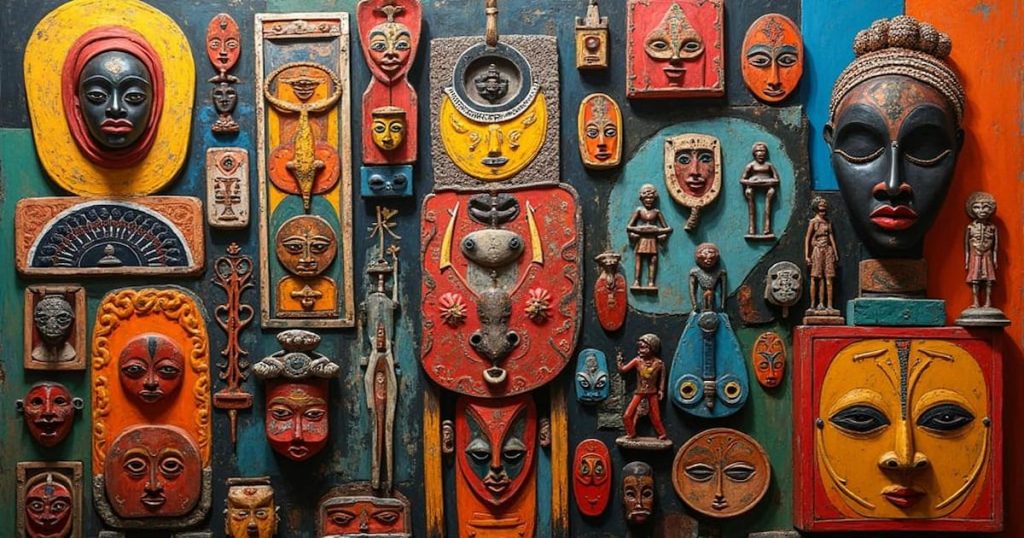
Across the African continent, wood sculpture stands as a testament to the creativity, spirituality, and resilience of its peoples.
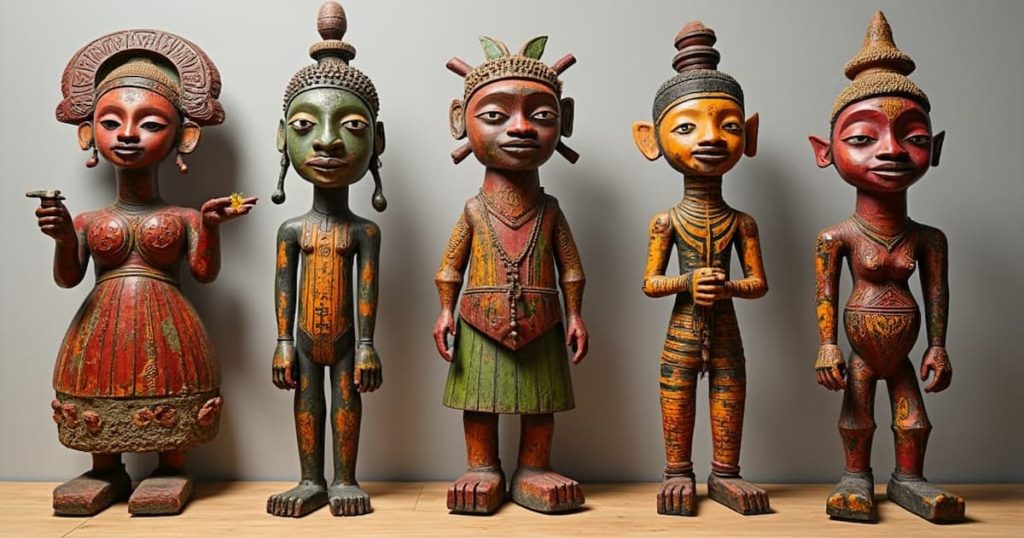
From the Yoruba of Nigeria to the Dogon of Mali, the Baule of Côte d’Ivoire, and the Shona of Zimbabwe, these cultures have crafted wooden masterpieces that embody their worldviews, histories, and aspirations.
These sculptures, often imbued with spiritual significance, challenge Western stereotypes of African art as “primitive” and reveal the Global South’s profound contributions to global aesthetics.
This blog explores the history, cultural significance, and enduring legacy of wood sculpture among the Yoruba, Dogon, Baule, and Shona, amplifying African voices while offering a hopeful vision for cultural appreciation and societal progress.
Historical Context: Wood Sculpture in African Societies
Wood sculpture in Africa is deeply rooted in the continent’s diverse cultural and historical landscapes.
Unlike stone or metal, wood was abundant, versatile, and accessible, making it a primary medium for artistic expression across sub-Saharan Africa.
From the 10th century onward, as African societies developed complex political systems, trade networks, and religious practices, wood sculpture became a dynamic tool for expressing identity, spirituality, and power.
The Yoruba, centred in southwestern Nigeria, flourished as a cultural and political force from the 11th century, with cities like Ilé-Ifẹ̀ and Owo serving as artistic hubs. Their wood sculptures, often linked to religious rituals, reflected a cosmology where deities (orishas) and ancestors played central roles.
The Dogon, in Mali’s Bandiagara Escarpment, developed their art within a cliff-dwelling society from around the 15th century, using wood to create sculptures that mediated between the human and spiritual realms.
The Baule, in Côte d’Ivoire, emerged as a distinct group in the 18th century, crafting wood figures that balanced aesthetic beauty with spiritual function.
The Shona of Zimbabwe, with a history tied to the Great Zimbabwe civilisation (11th–15th centuries), saw a modern sculptural renaissance in the 20th century, blending tradition with contemporary innovation.
These societies were not isolated. Trans-Saharan and coastal trade routes connected them to global networks, facilitating the exchange of goods such as gold, salt, and ivory.
This economic vitality supported artistic patronage, with rulers, priests, and communities commissioning sculptures for rituals, governance, and social cohesion.
Despite colonial disruptions in the 19th and 20th centuries, these traditions endured, adapting to new contexts while preserving their cultural essence.
Yoruba Wood Sculpture: Spiritual and Social Narratives
Yoruba wood sculpture is renowned for its intricate detail and spiritual depth. Often carved from iroko or ebony, these works served as ritual objects, embodying the Yoruba concept of ase (spiritual energy).
Common forms include ere ibeji (twin figures), epo masks for Gelede festivals, and shrine figures for orishas like Eshu, the trickster deity.
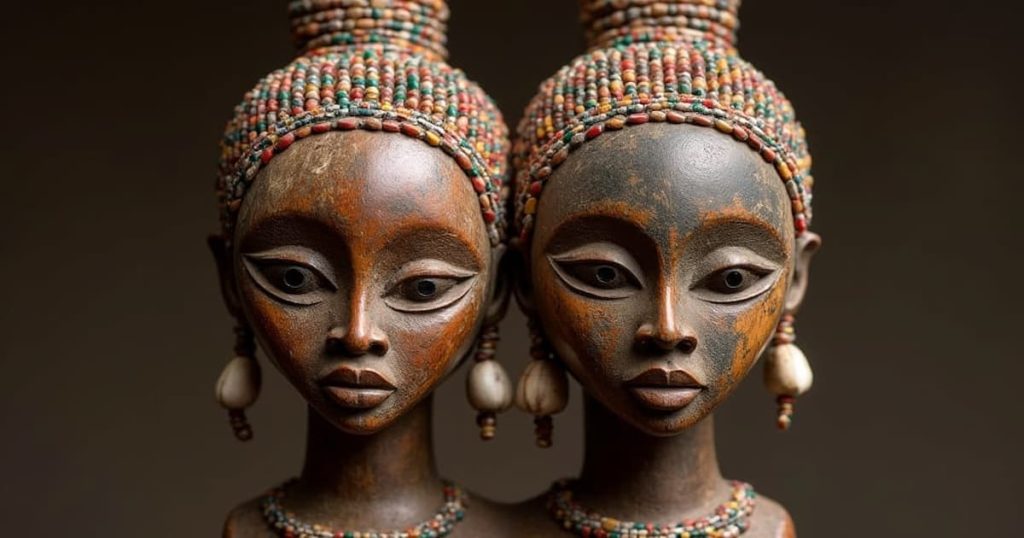
The ere ibeji, small figures carved to honour deceased twins, are particularly significant, reflecting the Yoruba’s high twin birth rate and belief in twins’ spiritual potency.
These sculptures, often adorned with beads and cowrie shells, feature exaggerated heads to signify ase and are treated as living entities, clothed and fed by families.
Yoruba masks, used in festivals such as Gelede to honour female ancestors, feature dynamic forms with vibrant colours and elaborate headdresses.
The Gelede mask, with its serene face and superstructure depicting animals or humans, balances male and female energies, promoting social harmony.
Yoruba carvers, organised in guilds, passed techniques through generations, ensuring continuity. As historian Rowland Abiodun notes, these sculptures are “visual metaphors” for Yoruba philosophy, encoding complex ideas about balance, community, and divinity.
Colonialism disrupted Yoruba art, with missionaries destroying “idols” and markets shifting toward Western buyers. Yet, the resilience of Yoruba sculptors, who adapted by creating works for tourists while maintaining ritual pieces, preserved their tradition.
Today, the Owo Museum and Lagos’s National Museum showcase these works, affirming their cultural significance.
Dogon Wood Sculpture: Cosmic Connections
The Dogon, living in Mali’s rugged Bandiagara Escarpment, are celebrated for their wood sculptures that reflect a complex cosmology.
Carved from hardwoods like baobab, Dogon figures often depict ancestors, mythical beings, or nommo (primordial spirits).
These sculptures, used in funerary rituals like the dama ceremony, guide souls to the afterlife. The togu na (men’s house) pillars, adorned with carvings of ancestors and animals, symbolise community strength, while kanaga masks, with their cross-shaped superstructures, represent the connection between earth and sky.
Dogon art is characterised by angular, abstract forms, contrasting with Yoruba naturalism. Figures often have elongated limbs and stylised features, reflecting a focus on spiritual essence over physical likeness.
The sigui festival, held every 60 years, features masks that reenact the Dogon creation myth, linking art to cosmic cycles. As art historian Kate Ezra explains, Dogon sculptures are “not just objects but active participants in ritual,” embodying spiritual agency.
Colonial French administration and missionary activity in the 19th century looted many Dogon works, now housed in Western museums like the Louvre.
This loss disrupted local practices, but Dogon carvers adapted, creating pieces for global markets while maintaining sacred traditions. Modern Dogon communities continue to produce sculptures, balancing cultural preservation with economic needs.
Baule Wood Sculpture: Harmony and Elegance
The Baule of Côte d’Ivoire are renowned for their polished wood sculptures, which blend aesthetic refinement with spiritual purpose.
Emerging in the 18th century after migrating from Ghana, the Baule crafted figures like blolo bla (spirit spouse) statues, believed to represent otherworldly partners who ensure personal harmony.
These figures, often male or female, feature serene faces, scarification patterns, and elegant postures, carved from softwoods like sese. Baule masks, used in goli dances, depict animals or human faces, celebrating life’s cycles and social unity.
Baule art emphasises balance, reflecting their belief in complementary forces, male and female, human and spirit. The mblo mask, with its smooth surfaces and idealised features, is a portrait of a living person, used in performances to honour community members.
As anthropologist Susan Vogel notes, Baule sculptures are “objects of beauty and power,” designed to please both humans and spirits.
Colonialism and the global art market challenged Baule traditions, with many works sold to Western collectors.
However, Baule artists adapted, creating pieces for export while preserving ritual sculptures. Today, institutions like the Musée National de Côte d’Ivoire celebrate Baule art, fostering local pride and global recognition.
Shona Wood Sculpture: Tradition Meets Modernity
The Shona of Zimbabwe, with roots in the Great Zimbabwe civilisation, are known for their modern wood sculpture movement, which emerged in the 1950s.
While traditional Shona art used stone (notably soapstone), wood became a key medium in the 20th century, reflecting both ancestral reverence and contemporary innovation.
Shona wood sculptures, often carved from ironwood or teak, depict spirits, animals, or abstract forms, embodying the concept of mudzimu (ancestral spirits).
The modern Shona sculpture movement, led by figures like Frank McEwen, who founded the National Gallery of Zimbabwe’s workshop school, blended traditional motifs with modernist aesthetics.
Artists like Bernard Matemera and Nicholas Mukomberanwa created fluid, organic forms that expressed spiritual and social themes.
Unlike Yoruba or Dogon art, Shona wood sculpture often engages global audiences, with pieces displayed in galleries from London to New York.
Colonial land dispossession and economic hardship drove many Shona to sculpture as a livelihood, transforming traditional practices into a global art form.
This adaptability highlights the Shona’s resilience, though it raises questions about commercialisation’s impact on cultural authenticity. As art historian Anitra Nettleton observes, Shona sculpture “bridges the ancestral and the modern,” maintaining spiritual roots while embracing global dialogue.
Western Perceptions and Critique
Western engagement with African wood sculpture has been marked by both admiration and misunderstanding.
In the early 20th century, colonial collectors and ethnographers labelled these works “fetishes,” ignoring their cultural context.
The 1907 Picasso-inspired Cubist movement drew heavily from African masks, including Yoruba and Baule forms, yet rarely credited their origins, perpetuating a narrative of African art as raw material for Western innovation.
This appropriation, as scholar Okwui Enwezor argues, “stripped African art of its agency,” framing it as primitive rather than sophisticated.
The looting of African sculptures during colonialism, with many Yoruba, Dogon, and Baule works now in Western museums, remains a contentious issue.
The 2018 Sarr-Savoy report called for repatriation, yet progress is slow. For instance, Dogon masks in the Musée du Quai Branly face ongoing restitution debates.
This colonial legacy contrasts with the growing global appreciation of African art, seen in exhibitions like the 2017 “African Art Now” at the Smithsonian, which featured Shona sculptures alongside Yoruba and Baule works.
A balanced critique acknowledges Western efforts to elevate African art through exhibitions and scholarship, but these must be paired with restitution and support for African institutions.
By centring African voices, like Yoruba scholar Babatunde Lawal or Shona artist Tapfuma Gutsa, we can reframe the narrative, recognising these sculptures as products of cultural genius rather than colonial trophies.
Challenges and Resilience
Wood sculpture faces challenges, including environmental degradation and the loss of traditional materials like iroko due to deforestation.
Economic pressures push artists toward commercial markets, risking the dilution of cultural significance.
For example, Baule carvers produce tourist-oriented pieces alongside ritual objects, creating a tension between authenticity and economic survival.
Yet, African communities have shown remarkable resilience.
Yoruba carvers maintain guild traditions, passing skills to new generations.
Baule artists balance local and global demands, while Shona sculptors have turned economic hardship into a globally recognised art movement. These adaptations reflect the Global South’s ability to navigate modernity while honouring heritage.
A Hopeful Vision for the Future
The wood sculptures of the Yoruba, Dogon, Baule, and Shona are more than artefacts; they are living expressions of African identity, spirituality, and creativity.
Their history challenges Western narratives that marginalise the Global South, revealing instead a continent that has shaped global aesthetics for centuries. By amplifying African voices, through scholarship, exhibitions, and repatriation, we can foster a more inclusive art history that values the contributions of all cultures.
The resilience of these traditions offers hope for societal progress. Yoruba ere ibeji teach us about community and care, Dogon masks remind us of our cosmic connections, Baule figures model balance, and Shona sculptures bridge tradition and modernity.
Supporting African artists, museums, and cultural initiatives can ensure these traditions thrive, while global partnerships can promote mutual understanding.
As we confront issues like cultural restitution and environmental sustainability, the legacy of African wood sculpture inspires a vision of a world where diverse voices are celebrated, and art serves as a bridge for unity and progress.
By honouring these masterpieces, we honour the Global South’s enduring contributions to humanity’s shared heritage.
Unveiling the Yoruba’s Masterpieces from the Heart of Africa
In the lush rainforests of southwestern Nigeria lies Ilé-Ifẹ̀, a city revered by the Yoruba people as the cradle of humanity and the spiritual heart of their culture. From the 11th to the 15th centuries, Ife was a political and religious centre and a hub of extraordinary artistic innovation.
The art of Ife, encompassing bronze, terracotta, and stone sculptures, stands among the most technically sophisticated and aesthetically compelling creations in global art history.
These works, often life-sized and strikingly naturalistic, challenged Western assumptions about African creativity and reshaped narratives about the continent’s historical contributions.
This blog explores the history of Ife art, its cultural significance, and its enduring legacy, while amplifying the voices of the Global South and offering a hopeful vision for reclaiming African narratives in a global context.
The Historical Context of Ife: A Cosmopolitan City-State
Ife, founded between 1000 BC and 500 BC, emerged as a significant urban centre by the 11th century CE, flourishing as the capital of the Yoruba kingdom in what is now Osun State, Nigeria.
According to Yoruba cosmology, Ife is the birthplace of humanity, created by the deity Obatala under the direction of the Supreme God Olódùmarè, with Oduduwa, another deity, establishing a dynasty that shaped Yoruba political and cultural identity.
This origin story, rich with spiritual and political significance, underscores Ife’s role as a sacred city, home to 401 deities (orishas) and vibrant festivals like the Olojo, celebrating divine authority and renewal.
By the 12th century, Ife was a cosmopolitan hub, thriving on trade networks that connected West Africa to regions as far as Mali, Mauritania, and Ghana.
Its economy, bolstered by iron-smelting technology, supported agriculture and commerce, with goods like glass beads, textiles, and iron tools fueling regional exchange.
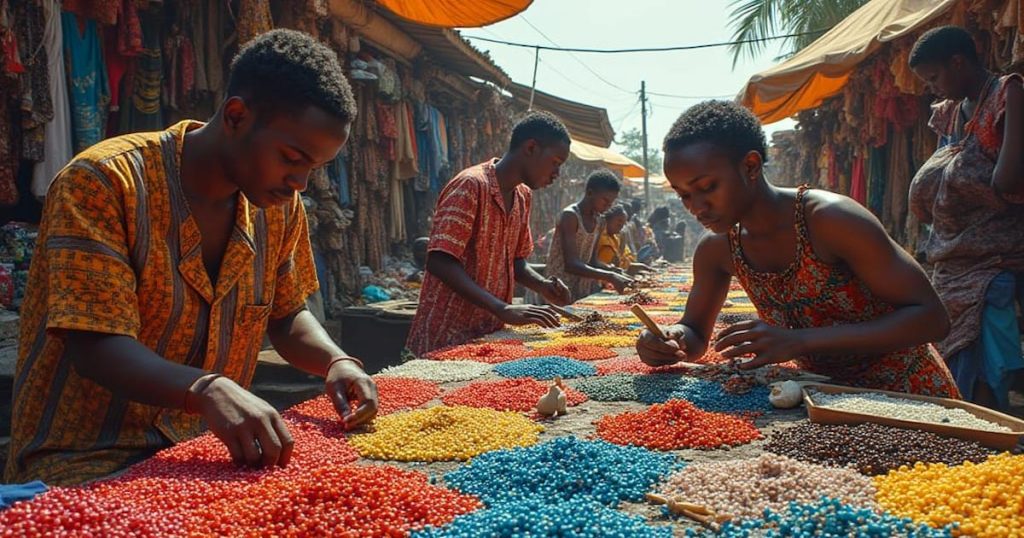
Ife’s glass bead industry, particularly from sites like Igbo Olokun, was renowned, with beads found across West Africa, highlighting the city’s participation in trans-Saharan and trans-Atlantic trade.
This economic vitality fostered a diverse society where artists, merchants, and rulers interacted, creating a fertile ground for artistic innovation.
Ife’s political structure, centred on the Ooni (king), was complex, with divine kingship balancing spiritual and temporal authority.
The city’s history was not without conflict; a civil war between supporters of Obatala and Oduduwa during the reign of the 46th Ooni left Ife vulnerable, yet its art flourished during this period, reflecting resilience and cultural synthesis.
This historical context is crucial to understanding Ife art, which was not merely decorative but a medium for expressing power, identity, and cosmology.
The Art of Ife: Masterpieces of Naturalism and Craftsmanship
Ife art, produced primarily between the 11th and 15th centuries, is celebrated for its naturalistic bronze, terracotta, and stone sculptures, which rank among the most technically advanced works of their time.
Unlike the stylised forms common in other African traditions, Ife sculptures display a remarkable realism, capturing individual features with precision.
Life-sized heads, often depicting royalty or dignitaries, feature symmetrical faces, almond-shaped eyes, full lips, and “beauty lines” (horizontal neck lines), embodying an idealised perfection.
As Yoruba historian Akinwumi notes, these works balance “absolute abstraction and absolute likeness,” reflecting the proverb, “It is death that turns an individual into a beautiful sculpture; a living person has blemishes.”
The bronze and copper alloy heads, crafted using the lost-wax casting technique, are among Ife’s most iconic creations. This method required immense skill, which involved creating a wax model, encasing it in clay, melting the wax, and pouring molten metal into the mould.
The resulting sculptures, such as the brass head of an Ooni from the 14th–15th century (now in the Museum of Ife Antiquities, Lagos), rivalled European Renaissance techniques in complexity.
Terracotta sculptures, often found in sacred groves like Ore and Iwinrin, depicted a cross-section of society, royalty, servants, and even diseased figures, showcasing the diversity of Ife’s social fabric.
Stone carvings, including monoliths and animal figures, added to the city’s artistic repertoire, often serving ritual purposes.
A standout piece is the bronze figure of a standing chief from Tada, Nigeria, dating to the 14th century. Dressed in a kilt-like garment and adorned with necklaces and a beaded hat, the figure holds a buffalo horn (likely a medicine container) and a staff, symbolising authority and spiritual power.
The veils often depicted in Ife art, covering the mouth or face, reflect the Yoruba concept of ase (spiritual energy), believed to reside in the head and requiring containment to protect others from its potency.
These sculptures were not mere portraits but ritual objects, used in funerary effigies or altars to honour ancestors and deities.
Ife’s artists also worked with glass, producing beads that served as currency and symbols of power. The glassmaking technology at Igbo Olokun, unique in West Africa, underscores Ife’s technological prowess, with beads found as far afield as Mali and Burkina Faso.
This diversity of materials, bronze, terracotta, stone, and glass, demonstrates the ingenuity of Ife’s artisans, who transformed raw materials into symbols of divine and political authority.
Cultural Significance: Art as Power and Identity
Ife art was deeply embedded in Yoruba cosmology and politics.
The head, central to Yoruba philosophy, was seen as the seat of ase, the life force that defined an individual’s essence.
This belief explains the prevalence of head sculptures, often oversized in proportion to the body, as seen in works like the terracotta head of an Ooni from the Yemisi Shyllon Museum of Art.
These sculptures were not just artistic but functional, used in rituals to mediate between the living, ancestors, and deities. Sacred groves like Ore and Iwinrin housed these works, where they played roles in worship and commemoration.
The art also reflected Ife’s political dynamics.
The copper alloy heads, possibly created during the reign of Obalufon II (14th century), are thought to have served a unifying purpose after a civil war between autochthonous groups and newcomers.
Art historian Suzanne Preston Blier argues that these works, with their varied scarification patterns and regalia, symbolised a cosmological synthesis of competing ethnic identities, fostering peace in a divided city.
Obalufon II, a patron of bronze casting and textiles, is credited with elevating Ife’s artistic tradition, making it a tool for diplomacy and cultural cohesion.
Ife’s art extended its influence beyond its borders, notably to the Kingdom of Benin, founded by a descendant of Ife’s dynasty.
Benin’s bronzes, while more stylised, share Ife’s realism and lost-wax technique, with oral traditions crediting Ife artisans for teaching Benin’s craftsmen.
This connection highlights Ife’s role as a cultural and artistic hub, shaping West African aesthetics and challenging the notion of isolated African societies.
Western Discovery and Misconceptions
The global recognition of Ife art began in 1910 when German ethnographer Leo Frobenius unearthed bronze and terracotta heads.
Stunned by their realism, Frobenius, steeped in colonial biases, attributed them to the mythical Greek colony of Atlantis, denying African authorship.
His claim that they were created by a “race far superior to the Negro” reflected the era’s racist assumptions, which dismissed African capacity for sophisticated art.
The discovery of additional heads in 1938, under the oversight of Ooni Adesoji Aderemi, further debunked these theories, affirming the art’s Yoruba origins.
Nigerian archaeologist Ekpo Eyo later criticised Western scholars for their “preconceived notions of so-called Western civilisation,” which blinded them to Africa’s creative legacy.
The 1910 discovery forced a reevaluation of African art, previously labelled “primitive” by colonial powers.
A 1948 article in the Illustrated London News compared Ife’s sculptures to the finest works of Italy and Greece, calling them the “Donatellos of medieval Africa.”
Exhibitions like the British Museum’s “Kingdom of Ife: Sculptures from West Africa” (2010) and “Dynasty and Divinity: Ife Art in Ancient Nigeria” further elevated its status, with critics hailing the works as “treasures of the human spirit” comparable to the Terracotta Army or the Parthenon.
Yet, the looting of Ife artefacts, such as a bronze sculpture intercepted in 1987, underscores the ongoing challenge of repatriation and the colonial legacy of cultural theft.
Critiquing Western Narratives
Western engagement with Ife art reveals a broader pattern of misunderstanding and appropriation.
The initial attribution of Ife’s sculptures to non-African origins reflects a colonial mindset that undervalued African contributions to global culture.
This Eurocentrism marginalised the Global South, framing its histories as peripheral to a Western-defined “universal” narrative.
Even today, many Ife masterpieces reside in Western museums, raising ethical questions about cultural heritage and restitution.
The British Museum’s retention of Ife bronzes, unlike the Benin Bronzes, which have faced stronger repatriation demands, highlights inconsistencies in addressing colonial looting.
Yet, this critique is not merely accusatory.
The global appreciation of Ife art, spurred by exhibitions and scholarship, has begun to reshape perceptions, offering opportunities for cross-cultural dialogue.
By centring African voices—like those of Yoruba scholars Rowland Abiodun and Babatunde Lawal—the narrative shifts from Western discovery to African agency. Their work emphasises Ife’s art as a product of local genius, rooted in Yoruba philosophy and innovation, rather than external influence.
The Decline of Ife and Its Artistic Legacy
Ife’s artistic tradition waned in the early 15th century, likely due to a combination of smallpox epidemics, drought, and shifting trade routes that diminished the city’s economic and demographic vitality.
The reign of Obalufon II, marked by these calamities, saw a decline in patronage for the arts, as sculptors lost support and the population dispersed. Despite this, Ife’s legacy endured through neighbouring kingdoms like Oyo and Benin, which adopted its artistic techniques and iconography.
The Yoruba diaspora further carried Ife’s cultural heritage to the Americas, influencing art and religion in Cuba, Brazil, and the United States.
Today, Ife remains a spiritual and cultural centre, with shrines and groves preserving its sacred traditions.
The Ooni of Ife, currently Oba Adeyeye Enitan Ogunwusi, continues to embody the city’s divine kingship, while institutions like the Yemisi Shyllon Museum of Art and Obafemi Awolowo University promote its artistic heritage.
The modern Ife Art School, established in the 1970s, builds on this legacy, training artists who blend traditional Yoruba aesthetics with contemporary forms.
A Hopeful Vision for the Future
The history of Ife art offers profound lessons for today’s world. Its technical sophistication and cultural depth challenge stereotypes of African societies as “primitive,” affirming the Global South’s role in shaping global civilisation.
By reclaiming these narratives, we can foster a more inclusive understanding of history that values African contributions alongside those of Europe, Asia, or the Americas. The resilience of Ife’s artists, who created enduring works amidst political and environmental challenges, inspires hope for societal
The decline of Ife’s artistic production in the 15th century did not erase its influence.
The Yoruba worldview, which sees Ife as the origin of humanity, continues to shape cultural and religious practices. Modern Yoruba communities maintain a plurality of beliefs, traditional, Islamic, and Christian, yet remain united by a shared heritage rooted in Ife’s legacy.
This enduring cultural cohesion offers a model for societies grappling with diversity and division, demonstrating how art and ritual can bridge differences and foster unity.
Amplifying African Voices in Ife’s Legacy
To fully appreciate Ife art, we must centre African perspectives, particularly those of Yoruba scholars and communities.
Western narratives, like Frobenius’s Atlantis theory, often overshadowed local interpretations, framing Ife’s achievements through a colonial lens.
Yoruba scholars like Rowland Abiodun emphasise the spiritual and philosophical underpinnings of Ife art, noting that sculptures were not mere objects but embodiments of ase, used in rituals to connect the living with ancestors and deities.
Babatunde Lawal highlights how Ife’s naturalistic style reflects a Yoruba aesthetic of idealised beauty, where physical imperfections are transcended to convey divine perfection.
These perspectives reveal the art’s purpose as a mediator of spiritual and political power, not just an aesthetic achievement.
The global diaspora of Yoruba culture further amplifies Ife’s significance.
In the Americas, Yoruba traditions, carried through the transatlantic slave trade, influenced religious practices like Santería in Cuba and Candomblé in Brazil.
Ife’s artistic legacy, with its focus on divine kingship and ritual, resonates in these diasporic expressions, where sculptures and altars continue to serve spiritual functions.
This global reach underscores the universal relevance of Ife’s art, challenging Western-centric art histories that marginalise African contributions.
Constructive Critique of Western Engagement
The Western encounter with Ife art reveals both progress and persistent challenges.
The early 20th-century dismissal of African authorship reflects a broader colonial tendency to deny the Global South’s agency.
This mindset justified the removal of artefacts to Western museums, where many Ife bronzes and terracottas remain.
The British Museum’s 2010 exhibition, while celebrated, raised questions about ownership, as most displayed works were from African collections, unlike the controversially acquired Benin Bronzes.
The lack of consistent repatriation efforts for Ife artefacts highlights an ethical gap in global heritage management.
However, Western recognition of Ife art has also sparked positive change.
Exhibitions have elevated their status, with critics comparing them to global masterpieces like the Parthenon sculptures.
This shift challenges the historical devaluation of African art and opens avenues for collaboration.
Partnerships, like the 2010 exhibition co-organised with Nigeria’s National Commission for Museums and Monuments, demonstrate how mutual respect can amplify African voices.
The challenge lies in moving beyond display to repatriation and supporting local institutions like the Yemisi Shyllon Museum of Art, which preserve Ife’s heritage in situ.
Ife Art in the Modern Context
Today, Ife remains a living cultural centre.
The Ooni, as a custodian of tradition, oversees festivals and shrines that maintain the city’s spiritual role.
The Obafemi Awolowo University, formerly the University of Ife, has been instrumental in studying and promoting Yoruba culture since the 1960s, with its Institute of African Studies fostering research and art education.
The Ife Art School, established in the 1970s, trains artists who blend traditional motifs with contemporary styles, ensuring the art’s relevance in a globalised world.
The global art world is increasingly recognising Ife’s influence.
Its naturalistic style has inspired modern African artists, from Nigeria’s Nsukka School to sculptors across the continent.
The Yemisi Shyllon Museum of Art, housing Ife artefacts, serves as a model for local stewardship, countering the narrative of Western museums as the sole guardians of African heritage.
These efforts reflect a broader movement to reclaim African narratives, emphasising self-determination and cultural pride.
Challenges and Opportunities
The preservation of Ife art faces challenges, including environmental threats to archaeological sites and the economic pressures of globalisation.
The loss of patronage in the 15th century, compounded by smallpox and drought, mirrors modern challenges like funding shortages for cultural institutions. Yet, these challenges present opportunities.
Digital archiving, community-led conservation, and international partnerships can protect Ife’s heritage. Nigeria’s growing cultural tourism sector, centred on Ife’s shrines and museums, offers economic potential while educating global audiences about Yoruba contributions.
The repatriation of looted artefacts remains a pressing issue. The 1987 interception of a stolen Ife bronze, valued at £20 million, underscores the scale of cultural theft.
Advocacy for restitution, led by African scholars and activists, aligns with global movements to address colonial legacies.
Collaborative models, like those seen in the 2010 exhibition, suggest a path forward where Western institutions support African-led initiatives without claiming ownership.
A Vision for Societal Progress
Ife’s art offers a blueprint for societal progress. Its creation during a time of conflict demonstrates how art can heal divisions, a lesson for today’s polarised world.
The synthesis of autochthonous and immigrant identities under Obalufon II shows the power of cultural expression to foster unity. Modern societies can draw on this by investing in arts education and cultural exchange to bridge divides.
The global impact of Ife art challenges the notion that innovation flows only from the Global North.
By integrating African perspectives into global curricula and exhibitions, we can create a more equitable narrative of human creativity.
Supporting institutions like the National Museum of African Art and local Nigerian museums ensures that Ife’s story is told by those who inherit its legacy.
Conclusion
The history of Ife art is a testament to the Yoruba people’s genius, creating sculptures that rivalled the world’s finest during a time of global medieval flourishing.
From the 11th to 15th centuries, Ife’s artists transformed bronze, terracotta, and stone into symbols of divine authority and cultural identity, shaping West African aesthetics and influencing global traditions through the Yoruba diaspora.
The Western discovery of Ife art, while initially marred by colonial biases, has sparked a reevaluation of African contributions, offering a chance to correct historical injustices.
By amplifying Yoruba voices and supporting local stewardship, we can honour Ife’s legacy while addressing modern challenges like repatriation and cultural preservation.
The resilience of Ife’s artists, who created beauty amidst adversity, inspires hope for a future where the Global South’s contributions are celebrated as integral to human history.
Ife’s art, with its serene faces and intricate craftsmanship, invites us to envision a world where cultural heritage unites rather than divides, fostering progress through shared understanding.
Sources:
Blier, Suzanne Preston. Art and Risk in Ancient Yoruba: Ife History, Power, and Identity c. 1300. Cambridge University Press, 2015.
Drewal, Henry John, and Schildkrout, Enid. Dynasty and Divinity: Ife Art in Ancient Nigeria. Museum for African Art, 2009.
Garlake, Peter. Early Art and Architecture of Africa. Oxford University Press, 2002.
The Metropolitan Museum of Art. “Ife (from ca. 6th Century).” Heilbrunn Timeline of Art History, 2014.
Smarthistory. “Kingdom of Ife: Sculptures from West Africa.” 2016.
National Geographic. “Nigerian Treasures: Ife Heads.” 2025.