Celebrating the Vibrancy of African Traditional Attire: A Cultural Journey

African Traditional Attire

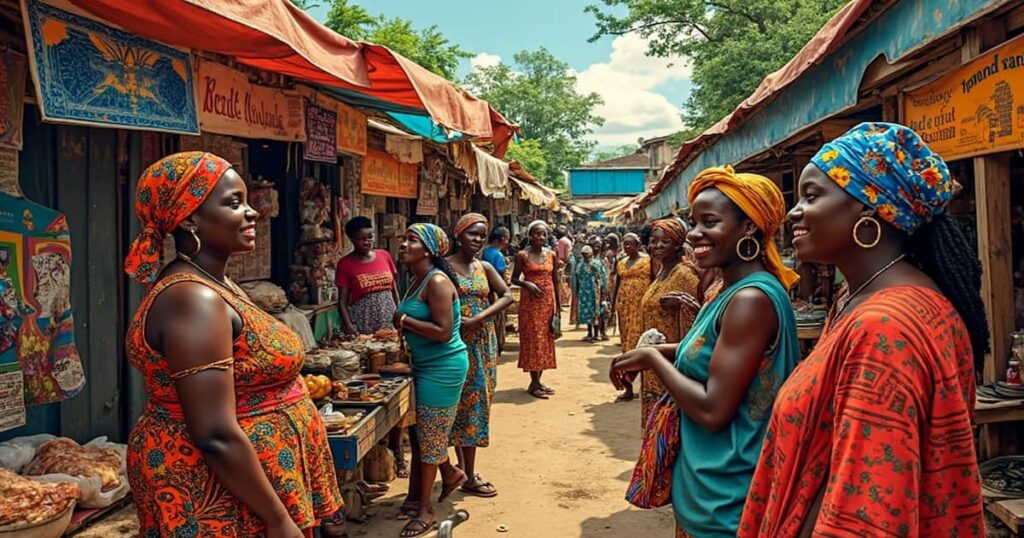
African traditional attire weaves a vibrant tapestry of culture, identity, and artistry across the continent.

African Distinctive Traditional Attire: A Tapestry of Culture, Identity, and Artistry

Africa, a continent of unparalleled diversity, is home to thousands of ethnic groups, each with its unique cultural heritage, traditions, and sartorial expressions. African traditional attire is more than just clothing; it is a vibrant canvas that tells stories of African history, identity, spirituality, and social status. This blog explores the significance, styles, materials, and contemporary influence of African traditional attire, celebrating its role in preserving heritage and shaping global African fashion.

From the intricate beadwork of the Maasai to the colourful Kente cloth of the Ashanti, African traditional attire weaves a vibrant tapestry of culture, identity, and artistry across the continent, reflecting the diverse heritage celebrated throughout African history, art, and fashion movements. This blog explores the significance, styles, materials, and contemporary influence of African traditional attire, celebrating its role in preserving heritage and inspiring modern African designers.

The Cultural Significance of African Traditional Attire

Traditional attire in Africa is deeply symbolic, serving as a visual language that communicates identity, status, and belonging. Clothing often conveys messages about a person’s tribe, marital status, age, or role within the community. For instance, among the Yoruba of Nigeria, specific colours and patterns in aso-oke fabric may signify a celebratory occasion like a wedding or a solemn event like a funeral. Similarly, the Zulu people of South Africa use beaded patterns to encode messages about love, fertility, or social standing.

For instance, among the Yoruba of Nigeria, specific colours and patterns in aso-oke fabric may signify a celebratory occasion like a wedding or a solemn event like a funeral. Similarly, the Zulu people of South Africa use beaded patterns to encode messages about love, fertility, or social standing.

Beyond personal expression, traditional attire is a marker of cultural pride. In many African societies, wearing traditional clothing during ceremonies, festivals, or rites of passage reinforces communal bonds and honours ancestral traditions. For example, during the Reed Dance ceremony in Eswatini, young women wear colourful beaded skirts and sashes, symbolising purity and cultural unity. These garments are not merely decorative but are imbued with spiritual and historical significance.

For example, during the Reed Dance ceremony in Eswatini, young women wear colourful beaded skirts and sashes, symbolising purity and cultural unity. These garments are not merely decorative but are imbued with spiritual and historical significance.

Traditional attire also serves as a form of resistance and resilience. During colonial eras, many African communities preserved their cultural identities through clothing, defying attempts to erase their heritage. Today, traditional attire continues to be a powerful statement of decolonisation and self-affirmation, especially in the face of globalisation and Western fashion influences.

Regional Diversity in African Traditional Attire

Africa’s vastness encompasses a multitude of climates, histories, and cultural practices, resulting in a stunning variety of traditional clothing. Below, we explore some iconic styles from different regions of the continent, each deeply rooted in its local heritage, identity, and expression of cultural pride.

West Africa: Vibrant Fabrics and Regal Elegance

West Africa is renowned for its bold, colourful textiles and elaborate designs. One of the most iconic fabrics is kente, originating from the Ashanti people of Ghana. Kente is a handwoven cloth made from silk and cotton, featuring intricate geometric patterns in vibrant hues like red, gold, green, and blue. Each colour and pattern carries specific meanings; for example, gold represents wealth and fertility, while green symbolises growth and renewal. Traditionally, kente was reserved for royalty and significant occasions, but today it is worn widely and has become a global symbol of African pride.

Ghana, Kente is also referred to as “Nwentoma” which simply means woven cloth.

This treasured fabric is not just an emblem of Ghanaian royalty, but a profound expression of West African craftsmanship. The weaving of kente involves age-old techniques passed down through generations, rooted in the cultural legacy of the Ashanti Kingdom. As it evolves in contemporary fashion, kente remains a vital symbol in festivals, weddings, and diasporic identity, playing a key role in the global celebration of African heritage. Its popularity has inspired artists and designers, solidifying its place in both traditional attire and modern design movements.

In Nigeria, the aso-oke fabric, woven by the Yoruba, is a staple for ceremonial wear.

This luxurious textile, often seen at weddings and festivals, is a hallmark of Nigerian cultural identity. The fabric is used to create traditional garments like the flowing agbada for men and the intricate gele headwraps for women—both of which serve as expressions of beauty, respect, and status. Aso-oke continues to influence global fashion trends, with modern designers incorporating it into high-end collections that elevate African aesthetics and promote pride in indigenous craftsmanship across the diaspora.

Nigerias’ the aso-oke fabric

Another notable West African attire is the boubou, a loose-fitting robe worn across the region, particularly in Senegal and Mali.

The grand boubou, known for its flowing elegance and detailed embroidery, is a staple of West African fashion and a symbol of status and refinement. In Senegal, the boubou is worn with pride during religious festivals and formal gatherings, while in Mali, it often reflects the wearer’s age, gender, and regional origin. As with many traditional garments, the boubou has inspired modern Afrocentric designs, bridging heritage and contemporary style in both local and global fashion scenes.

Senegals’ boubou attire

Malis’ boubou attire

East Africa: Beadwork and Pastoral Elegance

East African traditional attire often uses natural materials and intricate adornments.

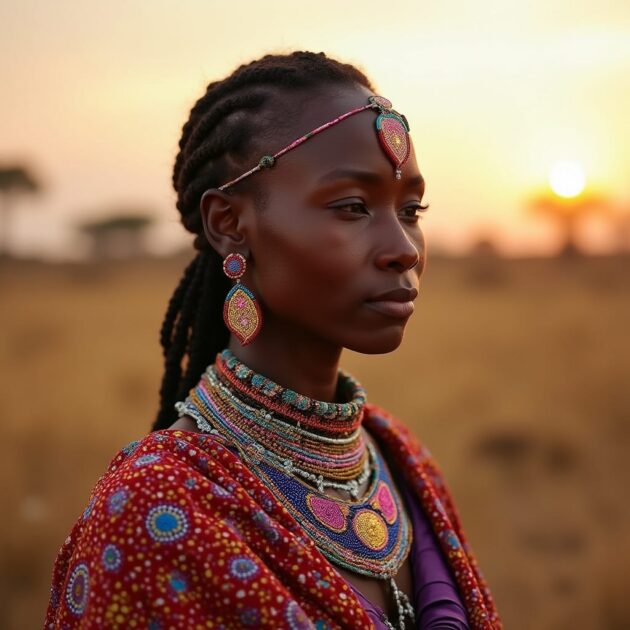
The Maasai of Kenya and Tanzania are instantly recognisable for their vibrant red shukas (cloaks) and elaborate beadwork. The red colour symbolises courage and protection, while the beads—carefully crafted by women—encode social meaning about age, marital status, and tribal identity. A Maasai bride may wear a richly adorned headdress and layers of beaded necklaces, each element narrating her passage into a new phase of life.

A semi-nomadic pastoralist community the Maasai traditional dress

In the Maasai community, every girl traditionally learns beadwork, a practice steeped in cultural importance and responsibility. This art form is not merely decorative—it is a vital expression of identity, storytelling, and generational knowledge. The colours and patterns used in Maasai beadwork communicate deep symbolic meaning, often conveying social roles or emotional messages. Beadwork is also worn during ceremonies such as initiations, weddings, and rites of passage, reinforcing communal bonds through shared visual language.

In Uganda, the gomesi or busuuti is a traditional dress worn by Baganda women. This floor-length, brightly colored garment with puffed sleeves and a sash is both elegant and practical, tailored for the region’s warm climate. The gomesi is typically worn during cultural ceremonies such as weddings, funerals, and introductions, symbolizing respect and tradition. Often paired with a headscarf, the gomesi is a visible marker of Ugandan heritage and pride. Its vibrant appearance and structured design highlight the fashion aesthetics of East Africa while its ceremonial use underscores the importance of ritual and community in African society.

Traditional wear for Baganda

A gomesi, is a traditional Ugandan women’s dress.

In Ethiopia, the netela and shamma are traditional white cotton shawls worn by both men and women.

These garments, adorned with colorful woven borders called tibeb, are draped over the shoulders during religious ceremonies and cultural events. The simplicity of the white fabric contrasted with the intricate embroidery reflects Ethiopia’s rich textile heritage and the spiritual purity often associated with Ethiopian Orthodox traditions. These timeless pieces echo the enduring influence of ancient civilizations and maintain their relevance in contemporary African fashion and identity.

Traditional clothing from Ethiopia

Southern Africa: Regal Skins and Beaded Splendour

In Southern Africa, traditional attire often incorporates animal hides, beads, and vibrant fabrics. Among the Zulu people of South Africa, clothing varies by occasion and social role. For women, the isidwaba, a pleated leather skirt, is worn by married women, often paired with beaded aprons and headbands. Men may wear the ibheshu, a leather garment covering the lower body during cultural ceremonies. Beadwork is central to Zulu attire, with specific colours and patterns conveying messages—white beads symbolising purity, and blue representing loyalty. These garments represent not just dress, but a deeply symbolic language of identity rooted in ancestral values and spiritual continuity.

For women, the isidwaba, a pleated leather skirt, is worn by married women, often paired with beaded aprons and headbands. Men may wear ibheshu, a leather garment covering the lower body, during cultural ceremonies. Beadwork is central to Zulu attire, with specific colours and patterns conveying messages; for instance, white beads symbolise purity, while blue beads represent loyalty.

An isidwaba is a traditional leather skirt worn by married Zulu women in South Africa. An ibheshu, made from animal hides, is a traditional garment worn by Zulu men.

In Eswatini, the emahiya is a traditional wrap worn by women, featuring bold patterns and vibrant colours. During the annual Reed Dance, young women don beaded skirts and sashes, showcasing the intricate artistry of Swazi craftsmanship and reinforcing their cultural values. In Botswana, the Herero dress—influenced by Victorian missionaries—is a voluminous gown with long sleeves and a headscarf shaped like cow horns, reflecting the community’s pastoral heritage and historical adaptation. These garments continue to evolve as modern symbols of heritage preservation and social pride, particularly among youth reclaiming indigenous identity through fashion.

North Africa: Flowing Robes and Ornate Embroidery

North African traditional attire is heavily influenced by Arab, Berber, and Islamic cultures. In Morocco, the djellaba is a long, loose-fitting robe worn by both men and women. Made from cotton or wool, the djellaba often features a pointed hood and intricate embroidery, showcasing the region’s rich design heritage. For special occasions, Moroccan women may wear a kaftan—a robe decorated with sequins and beads—which has gained global popularity for its elegance. In Egypt, the galabeya is a staple garment in rural areas, worn with turbans or headscarves. Meanwhile, in Tunisia and Algeria, the jellaba also reflects Berber influences, often featuring vibrant colours and geometric embroidery tied to local traditions.

For special occasions, Moroccan women may wear a kaftan, a richly decorated robe adorned with embroidery, sequins, and beads. The kaftan has gained global popularity for its elegance and versatility.

In Egypt, traditional attire includes the galabeya, a long, flowing robe worn by men and women in rural areas. For women, the galabeya may be paired with a headscarf, while men often wear it with a turban or cap.

The jellaba of Tunisia and Algeria shares similarities with the Moroccan djellaba, often featuring vibrant colours and geometric patterns inspired by Berber designs.

Central Africa: Woven Raffia and Symbolic Prints

Central African attire often incorporates natural materials like raffia and bark cloth. Among the Kuba people of the Democratic Republic of Congo, Kuba cloth is a masterpiece of textile art. Made from woven raffia, the fabric is dyed and embroidered with geometric patterns and worn during ceremonies. Women wear wraparound skirts called ntshak, paired with beaded belts and jewelry. In Cameroon, the toghu fabric—embroidered with vibrant thread on black cotton—is a mark of prestige and royal identity among the Bamileke people, especially during community events and funerals.

Materials and Craftsmanship

The materials used in African traditional attire reflect the continent’s natural resources and artisanal skills.

Textiles like cotton, silk, and wool are often handwoven on traditional looms. In West Africa, adire (tie-dye cloth) and bogolan (mud cloth) from Mali showcase intricate dyeing techniques. Adire, created by Yoruba women, features indigo patterns made through resist-dyeing, while bogolan uses fermented mud to craft earthy, geometric designs.

Beadwork is another hallmark of African attire, especially in East and Southern Africa. Beads—crafted from glass, bone, or seeds—are meticulously strung into necklaces, bracelets, and clothing embellishments. Leather and animal hides are widely used in pastoral communities such as the Zulu and Maasai for garments like skirts and cloaks.

Raffia, derived from palm trees, is essential in Central African textiles, while bark cloth, made from tree bark, is used by the Baganda of Uganda. These sustainable materials reflect a long-standing tradition of ecological harmony in African craftsmanship.

Contemporary Influence and Global Impact

African traditional attire has transcended borders, influencing global fashion and pop culture. Designers like Lisa Folawiyo in Nigeria and Laduma Ngxokolo in South Africa have reimagined traditional fabrics like ankara and Xhosa beadwork for contemporary fashion runways. The vibrant prints of Ankara and Kente have inspired international brands, appearing in everything from haute couture to streetwear.

The rise of Afrocentric fashion has empowered diaspora communities to reconnect with their roots. Events like Africa Fashion Week and the popularity of headwraps in the U.S. and Europe showcase the global appeal of African aesthetics. Celebrities like Beyoncé and Rihanna have embraced African-inspired designs, amplifying their cultural relevance.

However, the commercialisation of traditional attire raises concerns about cultural appropriation. When non-African designers adopt sacred patterns without acknowledging their origins, they risk diluting cultural meaning. Ethical fashion advocates urge recognition of African artisans and support for local creators to ensure cultural preservation and economic empowerment.

Preservation and Challenges

Preserving African traditional attire requires balancing tradition with modernity. As urbanisation and globalisation increase, many younger generations gravitate toward Western clothing, threatening the survival of indigenous craftsmanship. To counter this, initiatives such as textile cooperatives and fashion schools in countries like Ghana and Nigeria are teaching weaving, dyeing, and beading techniques to a new generation of artisans.

Climate change presents another challenge, impacting the availability of natural resources such as cotton and raffia. In response, many communities are adopting sustainable practices like organic farming and eco-friendly dyeing to preserve their textile traditions while protecting the environment.

Conclusion

African traditional attire is a testament to the continent’s cultural richness and artistic ingenuity. From the regal kente of Ghana to the beaded splendour of the Maasai, these garments are more than fashion—they are living expressions of history, identity, and resilience.

As African designers and global advocates continue to celebrate these traditions, traditional attire remains a powerful symbol of cultural pride and a bridge between past and future. Whether worn in a village ceremony or on a Paris runway, African traditional attire continues to captivate and inspire, reminding the world of the continent’s enduring legacy.

Celebrating the Vibrant Heritage of African Music and Dance

African Dance

African music and dance, vibrant and diverse, weave stories and rhythms, shaping culture and identity

Africa, a continent of unparalleled cultural diversity, is home to a vibrant and intricate tapestry of music and dance traditions that have shaped its identity for centuries. With over 54 countries, thousands of ethnic groups, and countless languages, African music and dance are as diverse as the people who create them.

These art forms are not merely entertainment; they are deeply rooted in the social, spiritual, and political fabric of African societies. From the rhythmic drumming of West Africa to the intricate footwork of Southern African dances, these traditions tell stories of history, community, resistance, and celebration. This blog explores the rich heritage of African music and dance, their cultural significance, their evolution, and their global influence.

The Cultural Significance of African Music and Dance

In African societies, music and dance are inseparable from daily life. They serve as vehicles for storytelling, preserving history, and passing down traditions across generations. Unlike Western traditions, where music and dance are often performed for entertainment or artistic expression, these art forms are deeply functional in Africa.

They accompany rituals, ceremonies, and rites of passage, such as births, initiations, weddings, and funerals. They also play a role in community bonding, spiritual worship, and even political expression.

Music and dance in Africa are communal activities. They bring people together, fostering a sense of unity and shared identity.

For example, among the Yoruba people of Nigeria, music and dance are integral to festivals honouring deities like Sango, the god of thunder. Drummers, singers, and dancers perform in unison, creating a collective experience that strengthens community ties.

Similarly, the Maasai of Kenya and Tanzania use their iconic jumping dance, known as Adumu, during warrior initiation ceremonies, symbolising strength and agility.

Rhythm is the heartbeat of African music and dance.

Polyrhythms, multiple rhythms played simultaneously, are a hallmark of many African musical traditions.

These complex rhythmic patterns, often created by drums, are not just musical but also communicative. In many cultures, drums are considered sacred instruments that convey messages, summon spirits, or mark significant events.

The djembe, a goblet-shaped drum from West Africa, is one such instrument, widely used in Mali, Guinea, and Senegal to accompany dances and rituals.

Regional Diversity in African Music and Dance

Africa’s vastness contributes to its incredible diversity in musical and dance styles. Each region has developed unique traditions influenced by geography, history, and cultural exchange. Below is an overview of some key regional traditions.

West Africa: The Pulse of Drumming and Griot Traditions

West Africa is renowned for its drumming traditions and the role of griots, oral historians and musicians who preserve the history of their people through song. The griot tradition, found among the Mandinka, Wolof, and other ethnic groups, is a cornerstone of West African culture.

Griots, often accompanied by the kora (a 21-stringed harp-lute), sing epic tales of kings, warriors, and ancestors. Their music is both a historical record and a form of social commentary.

Dance in West Africa is equally dynamic, often characterised by vigorous movements and intricate footwork. The Sabar dance of Senegal, performed to the rapid rhythms of the sabar drum, is a prime example.

Dancers move with precision, their bodies responding to the drum’s call-and-response patterns. Similarly, the Kpanlogo dance of Ghana’s Ga people blends traditional rhythms with modern influences, reflecting the region’s history of cultural fusion.

East Africa: Melodic Harmonies and Ritual Dances

East African music and dance are marked by melodic instruments and communal participation. In Kenya and Tanzania, the taarab music of the Swahili coast blends African, Arab, and Indian influences, featuring instruments like the oud and violin.

Taarab performances often accompany weddings and social gatherings, with singers delivering poetic lyrics about love and life.

The Maasai’s Adumu dance, mentioned earlier, is a striking example of East African dance. Performed by young warriors, it involves high jumps and synchronised movements, showcasing physical prowess and group cohesion. In Uganda, the Amaggunju dance, traditionally performed for the Buganda kings, uses rapid footwork and expressive gestures to tell stories of royal lineage.

Southern Africa: Polyphony and Liberation Movements

Southern African music is known for its rich vocal harmonies and polyphonic singing. The mbube style, popularised globally by groups like Ladysmith Black Mambazo, features layered vocals that create a hauntingly beautiful sound. This style, originating among the Zulu people of South Africa, has roots in both sacred and secular traditions.

Dance in Southern Africa often reflects historical and political contexts. The gumboot dance, born in South Africa’s mining communities during the apartheid era, is a powerful example. Miners, restricted from speaking, used rhythmic stomping and slapping of their boots to communicate. Today, gumboot dancing is a celebrated art form, symbolising resilience and creativity in the face of oppression.

Central Africa: The Forest’s Rhythmic Pulse

Central African music and dance are deeply tied to the region’s lush rainforests and spiritual traditions.

The Baka people of Cameroon and Gabon, for instance, use polyphonic singing and percussion to accompany their forest rituals.

Their music, often performed during hunting or healing ceremonies, mimics the sounds of the natural world.

The Makosa dance from Cameroon, popularised in the 20th century, blends traditional rhythms with modern influences like jazz and rumba.

It’s fluid, hip-shaking movements have made it a staple in African dance halls and a precursor to global styles like soukous.

North Africa: The Influence of Arab and Berber Traditions

North African music and dance reflect a blend of indigenous Berber, Arab, and Mediterranean influences. In Morocco, the Gnawa music tradition combines spiritual chants with hypnotic rhythms, often performed during healing rituals. The accompanying dance, characterised by acrobatic movements and trance-like states, is believed to connect participants with spiritual forces.

In Egypt, the tanoura dance, a Sufi whirling dance, is both a spiritual and artistic expression. Dancers spin continuously, their colourful skirts creating mesmerising patterns, symbolising the soul’s journey toward divine unity.

Instruments: The Soul of African Music

African music is defined by its instruments, which vary widely across regions but share a common role in storytelling and ritual.

Drums, such as the djembe, talking drum, and ngoma, are central to many traditions, serving as both musical and communicative tools.

The talking drum, used by the Yoruba and Hausa people, can mimic human speech through variations in pitch and rhythm.

Stringed instruments like the kora and ngoni are prevalent in West Africa, offering melodic accompaniment to vocal performances.

The mbira, or thumb piano, is a staple in Southern African music, particularly among the Shona people of Zimbabwe.

Its delicate, resonant tones are often used in spiritual ceremonies to invoke ancestors.

Wind and percussion instruments, such as the balafon (a wooden xylophone) and shekere (a beaded gourd rattle), add texture to African music.

These instruments are often crafted from natural materials, reflecting the deep connection between African cultures and their environment.

The Role of Dance in African Societies

Dance in Africa is more than a physical act; it is a language of expression, communication, and identity.

Each dance has a specific purpose, whether to celebrate, mourn, or mark a transition.

For example, the Kuku dance of the Susu people in Guinea is performed during harvest festivals to give thanks for abundance, while the Bikutsi dance of Cameroon’s Beti people is a lively celebration of femininity and community.

Dances are often gender-specific, with movements reflecting social roles. Among the Dogon people of Mali, men perform the Dama dance to honour the dead, using elaborate masks and stilts to represent spiritual beings.

Women, meanwhile, may perform dances like the Eswe of the Bamileke in Cameroon, which celebrates fertility and motherhood.

Call-and-response, a key feature of African music, extends to dance. Dancers respond to the rhythms and calls of drummers or singers, creating a dynamic interplay.

This interaction is evident in the Agbadza dance of the Ewe people in Ghana and Togo, where dancers’ movements mirror the drum’s intricate patterns.

Evolution and Modernisation

While African music and dance are deeply traditional, they are not static. Over time, they have evolved through contact with other cultures, colonisation, and globalisation.

The transatlantic slave trade, for instance, carried African rhythms and movements to the Americas, giving rise to genres like jazz, blues, samba, and salsa.

In Brazil, the capoeira dance, a martial art disguised as dance, reflects the resilience of enslaved Africans who preserved their culture under oppression.

In the 20th century, African music began to incorporate Western instruments and styles.

Highlife in Ghana and Nigeria blended traditional rhythms with jazz and brass bands, while Afrobeat, pioneered by Fela Kuti, fused African percussion with funk and political lyrics.

Today, genres like Afrobeats (distinct from Afrobeat) dominate global charts, with artists like Burna Boy and Wizkid blending African rhythms with pop, hip-hop, and electronic music.

Dance has also modernised. Urban dance styles like Azonto from Ghana and Kuduro from Angola have gained international popularity, driven by social media and music videos.

These dances retain traditional elements, such as rhythmic precision and storytelling, while embracing contemporary influences.

Global Influence and Challenges

African music and dance have left an indelible mark on the world. From the syncopated rhythms of jazz to the hip-shaking moves of reggaeton, African traditions have shaped global culture.

Festivals like WOMAD (World of Music, Arts and Dance) and performances by groups like the Soweto Gospel Choir have brought African artistry to international audiences.

However, these traditions face challenges. Globalisation and urbanisation threaten indigenous practices, as younger generations gravitate toward modern genres.

Preservation efforts, such as cultural festivals and education programs, are crucial to maintaining these traditions.

Additionally, the commercialisation of African music can sometimes strip it of its cultural context, reducing sacred rituals to mere entertainment.

Conclusion


The rich tradition of African music and dance is a testament to the continent’s cultural depth and resilience.

These art forms are more than aesthetic expressions; they are the lifeblood of African societies, carrying the weight of history, spirituality, and community.

From the polyrhythms of West African drums to the soulful harmonies of Southern African choirs, African music and dance continue to captivate and inspire. As they evolve and spread globally, they remind us of the power of culture to connect, heal, and celebrate the human spirit. By honouring and preserving these traditions, we ensure that the heartbeat of Africa continues to resonate for generations to come.

The Vibrant Diversity of African Cultures and Languages

Vibrant Diversity

Africa’s diversity is reflected in its 3,000+ ethnic groups and 2,000+ languages, shaped by a rich history.

Africa, often referred to as the “cradle of humanity,” is a continent of unparalleled cultural and linguistic diversity.

Home to over 1.4 billion people across 54 countries, it boasts thousands of ethnic groups, languages, and cultural practices that have evolved over millennia. This diversity is rooted in Africa’s deep history, from ancient civilisations to colonial disruptions and modern nation-building.

By tracing the chronological development of Africa’s cultures and languages, we can better understand its rich tapestry and global influence. This blog explores the evolution of African cultural and linguistic diversity, from prehistoric origins to the present day, highlighting key periods and their impact on the continent’s identity.

Prehistoric Foundations: The Dawn of Diversity (Before 3000 BCE)

Africa’s cultural and linguistic diversity began with the emergence of early human societies. Archaeological evidence, such as fossils found in Ethiopia’s Omo Valley dating back 200,000 years, confirms Africa as the birthplace of Homo sapiens. These early communities, including hunter-gatherer groups like the San in Southern Africa and the Hadza in East Africa, developed distinct ways of life shaped by their environments. The San, for example, created intricate rock art and oral traditions, laying the foundation for cultural diversity.

Linguistic diversity also emerged early. Linguists estimate that proto-languages, ancestors of modern African language families, began forming as communities spread across diverse ecosystems, deserts, savannas, forests, and coasts. The four major language families, Niger-Congo, Afroasiatic, Nilo-Saharan, and Khoisan, likely originated during this period. Khoisan languages, characterised by click consonants, were spoken by Southern African hunter-gatherers, while proto-Niger-Congo languages emerged in West Africa, setting the stage for the Bantu migrations.

These early societies, though small, established unique cultural practices, from storytelling to spiritual beliefs tied to nature, which remain evident in modern African traditions.

Ancient Civilisations and Cultural Flourishing (3000 BCE–1000 CE)

By 3000 BCE, Africa saw the rise of complex societies that enriched its cultural and linguistic landscape. In Northeast Africa, the Kingdom of Aksum (modern-day Ethiopia and Eritrea) developed a sophisticated culture, blending indigenous practices with influences from trade across the Red Sea. Aksumites spoke Ge’ez, an Afroasiatic language, and their script became one of Africa’s earliest writing systems, used in religious texts like the Bible after the kingdom adopted Christianity in the 4th century CE. Aksum’s art, architecture, and coinage reflected a fusion of African, Arabian, and Greco-Roman elements, showcasing early cultural syncretism.

In West Africa, modern Nigeria’s Nok culture (circa 1000 BCE–300 CE) produced intricate terracotta sculptures, indicating advanced artistic traditions. The Nok likely spoke proto-Bantu languages, part of the Niger-Congo family, which spread as Bantu-speaking groups migrated across Central, East, and Southern Africa between 1000 BCE and 500 CE.

These migrations, driven by agricultural advancements like yam and sorghum cultivation, spread languages and cultural practices, such as ironworking and communal governance, across vast regions. By 500 CE, Bantu-speaking communities had established diverse societies, each adapting to local environments, from the Swahili coast to the Great Zimbabwe precursor societies.
North Africa’s ancient civilisations, like the Kingdom of Kemet (Egypt), also contributed to linguistic and cultural diversity. Egyptian hieroglyphs, an Afroasiatic writing system, recorded a rich art, religion, and governance culture.

Meanwhile, Berber-speaking communities in the Maghreb developed distinct pastoral and trading cultures, with Tamazight languages diversifying into dialects still spoken today. These early civilisations laid the groundwork for Africa’s mosaic of ethnic identities, with each group developing unique customs, from Egyptian mummification to Nok pottery.

The Rise of Empires and Trade Networks (1000 CE–1500 CE)

The medieval period saw the emergence of powerful African empires that further diversified cultural and linguistic landscapes through trade, conquest, and cultural exchange. In West Africa, the Ghana Empire (circa 300–1200 CE) thrived on the gold and salt trade, fostering a cosmopolitan culture among Mande-speaking peoples.

The empire’s capital, Kumbi Saleh, was a melting pot where Islamic influences from North Africa blended with indigenous animist beliefs, creating syncretic practices like the use of griots, or historians and musicians who preserved Mande history in song.

The Mali Empire (1235–1600 CE), succeeding Ghana, amplified this cultural fusion. Under rulers like Mansa Musa, Mali became a global learning centre in Timbuktu, where scholars wrote in Arabic and local languages like Songhay and Fulfulde.

The empire’s wealth attracted traders from the Middle East and Europe, spreading Islamic art, architecture, and literacy while reinforcing the Niger-Congo language family’s dominance in West Africa. The Songhai Empire (circa 1400–1591 CE) continued this legacy, with Songhai becoming a primary language alongside Hausa and Wolof.

In East Africa, the Swahili city-states (circa 800–1500 CE) emerged along the coast, blending Bantu languages with Arabic to create Kiswahili, a lingua franca of trade. Swahili culture, characterised by coral-stone architecture and poetry, reflected influences from Persia, India, and Arabia, driven by Indian Ocean trade. Meanwhile, in Southern Africa, the Kingdom of Mapungubwe (circa 1075–1220 CE) showcased advanced goldwork and trade with Asia, with Shona-speaking communities laying cultural foundations for the later Great Zimbabwe.

These empires and trade networks fostered linguistic diversity by spreading languages like Arabic, Kiswahili, and Hausa. At the same time, cultural practices, such as Mali’s epic poetry or Swahili’s dhow-building, reflected local adaptations. However, this period also saw tensions, as ethnic groups competed for resources, shaping distinct identities like the Yoruba in Nigeria or the Akan in Ghana.

Colonial Disruption and Cultural Resilience (1500 CE–1900 CE)

The arrival of European colonial powers in the 15th century profoundly impacted Africa’s cultural and linguistic diversity. The transatlantic slave trade (1500–1800) forcibly removed millions of Africans, primarily from West and Central Africa, disrupting communities and scattering languages like Yoruba, Igbo, and Kongo to the Americas.

This diaspora created new African-influenced cultures abroad, but in Africa, it weakened ethnic groups and eroded oral traditions as communities were decimated.

By the 19th century, colonial partition under the 1884 Berlin Conference carved Africa into arbitrary borders, often splitting ethnic groups and languages. For example, the Ewe people were divided between British-controlled Gold Coast (Ghana) and German-controlled Togoland, complicating cultural cohesion. Colonial powers imposed European languages—English, French, Portuguese, and German—as administrative tools, marginalising indigenous languages. Dutch and British colonisation in South Africa introduced Afrikaans, a creole language, while suppressing Khoisan and Nguni languages like Xhosa and Zulu.

Despite these disruptions, African cultures showed resilience. Secret societies, like the Poro and Sande among the Mende in Sierra Leone, preserved traditional knowledge. Resistance movements, such as the Zulu under Shaka (early 1800s), reinforced cultural pride through military and social organisation.

In West Africa, the Sokoto Caliphate (1804–1903) unified Hausa and Fulani peoples under Islamic governance, promoting Hausa as a literary language while maintaining ethnic diversity. Similarly, the Asante Empire in Ghana preserved Akan culture through oral histories and kente cloth, even under British pressure.

Colonialism also introduced Christianity, which blended with indigenous beliefs to create syncretic religions, like the Aladura churches among the Yoruba. These adaptations ensured that cultural practices, from music to dance, endured, even as colonial languages began reshaping linguistic landscapes.

Post-Colonial Revival and Challenges (1900 CE–2000 CE)

The 20th century marked Africa’s struggle for independence and efforts to reclaim cultural and linguistic identity. As countries gained independence, Ghana in 1957, Nigeria in 1960, and others through the 1960s, leaders like Kwame Nkrumah and Jomo Kenyatta emphasised cultural revival. Pan-Africanism, championed by figures like W.E.B. Du Bois, promoted unity among Africa’s diverse ethnic groups, celebrating shared heritage through festivals like FESMAN (1966) in Senegal.

However, colonial legacies posed challenges. Newly independent nations inherited artificial borders, leading to ethnic conflicts, such as the Nigerian Civil War (1967–1970) between Igbo, Yoruba, and Hausa groups. Linguistic diversity complicated nation-building, as governments often adopted colonial languages—English in Nigeria, French in Senegal—as official languages to unify diverse populations. These marginalised indigenous languages, with only a few, like Kiswahili in Tanzania and Kenya, have gained official status.

Cultural revival efforts flourished despite these challenges. In Nigeria, the Yoruba-language theatre of Hubert Ogunde popularised indigenous storytelling, while in Senegal, Léopold Sédar Senghor’s Négritude movement celebrated African art and identity. Music genres like highlife in Ghana, jùjú in Nigeria, and mbalax in Senegal blended traditional rhythms with modern influences, showcasing cultural dynamism. Meanwhile, languages like Amharic in Ethiopia and Zulu in South Africa were standardised for education, preserving linguistic diversity.

Globalisation introduced new influences, from Hollywood to Nollywood, Nigeria’s booming film industry, which promoted Yoruba, Hausa, and Igbo languages. However, urbanisation and migration threatened smaller languages, like those of the Khoisan, with some facing extinction. By 2000, UNESCO estimated that Africa had over 2,000 languages, but many were endangered due to globalisation and dominant national languages.

Modern Africa: Celebrating and Preserving Diversity (2000 CE–Present)

Today, Africa’s cultural and linguistic diversity is both celebrated and challenged in a globalised world. The continent is home to over 3,000 ethnic groups and an estimated 2,000–3,000 languages, roughly one-third of the world’s total. Nigeria alone has over 500 languages, including Yoruba, Hausa, and Igbo, while Ethiopia’s 80+ ethnic groups speak languages from the Afroasiatic and Nilo-Saharan families. Kiswahili, now an official language of the African Union, is spoken by over 150 million people, reflecting Africa’s linguistic influence.

Cultural festivals, like Nigeria’s Durbar and South Africa’s Reed Dance, showcase ethnic traditions, from Hausa horsemanship to Zulu beadwork. Digital platforms have amplified African voices, with musicians like Burna Boy (Nigeria) and Black Coffee (South Africa) blending Afrobeat and amapiano with global sounds. Nollywood, producing over 2,500 films annually, promotes languages like Yoruba and pidgin English, while social media platforms like X highlight cultural pride, with users sharing traditional recipes or dances.

Yet, challenges persist. Urbanisation and education systems favouring English, French, or Arabic threaten smaller languages, with UNESCO reporting that half of Africa’s languages could vanish by 2100. Efforts like South Africa’s 11 official languages policy, including Xhosa and Sesotho, aim to preserve linguistic diversity, but implementation is uneven. Cultural homogenization, driven by global media, also risks diluting traditions, though initiatives like Ghana’s “Year of Return” (2019) have revitalised diaspora connections to African heritage.

Technology offers hope for preservation. Apps like Twi Teacher (for Ghana’s Akan language) and digital dictionaries for languages like Shona and Wolof support language learning. Organisations like the African Language Materials Archive digitise oral traditions, while universities in Kenya and South Africa develop curricula in indigenous languages. Meanwhile, cultural exchanges, such as Nigeria’s collaboration with Brazil to promote Yoruba culture, highlight Africa’s global influence.

Conclusion: A Tapestry of Resilience

Africa’s cultural and linguistic diversity is a testament to its resilience through millennia of change. From prehistoric hunter-gatherers to ancient empires, medieval trade networks, colonial disruptions, and modern globalisation, the continent has woven a complex tapestry of over 3,000 ethnic groups and 2,000 languages. Each period—marked by innovation, adaptation, and resistance—has enriched this diversity, from Aksum’s Ge’ez script to Nollywood’s cinematic storytelling. While challenges like language loss and cultural homogenization persist, Africa’s commitment to celebrating its heritage through festivals, education, and technology ensures its legacy endures. As the continent navigates the 21st century, its diverse cultures and languages remain a vibrant gift to the world, reflecting a history of unity in diversity.

Navigating Rejection: Why African Americans Face Challenges Returning to the Motherland

Motherland Rejections

African Americans face rejection in Africa due to cultural, economic, and historical divides. Explore why.

The transatlantic slave trade, which forcibly removed millions of Africans from their homeland between the 16th and 19th centuries, created a profound and lasting disconnection between African Americans and their ancestral continent. Enslaved Africans were stripped of their languages, cultures, and ethnic identities during the Middle Passage and subsequent centuries of slavery in the Americas.

As scholar Tunde Adeleke notes, this brutal process “accomplished the total destruction of the ethnic identity of African-Americans,” leaving them with little knowledge of their specific African origins. For many African Americans, Africa became a distant memory, a vague ancestral homeland rather than a tangible place tied to specific ethnic groups or regions.

This historical severance has shaped differing identities. African Americans developed a distinct culture in the United States, influenced by centuries of slavery, segregation, and the fight for civil rights.

Meanwhile, African societies evolved under colonialism, independence struggles, and modern nation-building. These divergent paths created two groups with shared ancestry but vastly different lived experiences.

When African Americans return to Africa, they often arrive with an idealised or romanticised view of the continent, expecting an immediate sense of belonging. However, as noted in the experience of Liberian settlers in the 19th century, “having an African ancestry and a black skin colour were definitely not enough” to be fully accepted by local populations.

In Liberia, African Americans were perceived as foreign settlers, akin to colonialists, due to their Americanized culture and lack of specific ethnic ties.

Cultural Misunderstandings and Stereotypes

One significant barrier to acceptance is the cultural gap between African Americans and Africans. African Americans, shaped by Western culture, often bring different social norms, communication styles, and expectations to African communities.

These differences can lead to misunderstandings. For example, posts on X highlight perceptions among some Africans that African Americans are “too ghetto, loud, chaotic, violent, and rude,” reflecting stereotypes that may stem from media portrayals or limited interactions.

Such generalisations, while not universal, can create friction when African Americans settle in African countries.


Conversely, African Americans may hold stereotypes about Africa, influenced by Western media depictions of the continent as “primitive” or “the Dark Continent.”

These portrayals can lead to unrealistic expectations, where African Americans anticipate a homogenous, welcoming “motherland” but encounter diverse societies with their own complexities.

For instance, African Americans may not anticipate the importance of tribal or ethnic affiliations in many African countries. As one X user pointed out, African Americans, as descendants of enslaved people from various regions, often lack identifiable ties to specific ethnic groups, which can make integration challenging in societies where tribal identity is significant.

Language barriers further exacerbate these issues. Most African Americans speak English or other Western languages, while many African communities use local languages or dialects.

This linguistic divide can hinder communication and reinforce the perception of African Americans as outsiders.

Additionally, cultural practices, such as communal living, respect for elders, or traditional gender roles, may differ significantly from African American norms, leading to unintentional offences or misunderstandings.

Economic Competition and Privilege Dynamics

Economic factors also play a role in the rejection some African Americans face. African immigrants in the U.S. and African Americans have historically competed for resources, such as jobs and educational opportunities, which can foster resentment.

Henry Ukazu, a Nigerian immigrant, noted that African immigrants are often willing to take low-wage, entry-level jobs that African Americans, as native-born citizens, may be less inclined to accept.

This dynamic can create a perception among Africans that African Americans are entitled or unwilling to “start from scratch,” which may carry over when African Americans relocate to Africa.

Moreover, African Americans often arrive in Africa with a degree of economic privilege, as they may have access to resources, education, or skills acquired in the U.S.

In countries like Ghana, where an estimated 3,000 to 5,000 African Americans live in Accra, locals sometimes perceive these newcomers as privileged outsiders who benefit from “American” status.

For example, Muhammida el-Muhajir, who moved from New York to Accra, noted that being American grants certain privileges in Ghana, but this can also lead to resentment among locals who see African Americans as competing for opportunities or driving up costs in urban areas.

The class system within African societies further complicates integration. As el-Muhajir observed, “if you take away race, there’s a class system” in places like Ghana.

African Americans, often arriving with professional skills or entrepreneurial ambitions, may inadvertently position themselves within a higher socioeconomic class, which can alienate locals who face economic challenges.

This dynamic mirrors historical tensions in Liberia, where Americo-Liberians, descendants of African American settlers, dominated the country’s political and economic systems, creating resentment among indigenous Liberians.

The Legacy of Pan-Africanism and Unrealistic Expectations

The Back-to-Africa movement has historical roots in Pan-Africanism, a philosophy advocating unity among people of African descent worldwide. Figures like Marcus Garvey in the early 20th century championed the idea of African Americans returning to Africa to build a unified, prosperous continent.

However, as historian Washington Hyde points out, the assumption that African Americans had a “right to return to and determine Africa’s future” often carried an imperialist undertone, alienating local Africans who saw them as outsiders imposing foreign values.

Today, some African Americans return with a Pan-Africanist vision, hoping to contribute to Africa’s development. However, this idealism can clash with local realities. Africans may view these efforts as paternalistic, especially if African Americans lack understanding of local political, social, or economic contexts.

For example, the Peace Movement of Ethiopia in the 1930s envisioned African Americans “healing” Liberia’s troubles, but this assumption disregarded the agency of local Liberians. Similarly, modern returnees may face scepticism if their contributions are perceived as self-serving or disconnected from local needs.

On the flip side, African Americans may feel disappointed when their expectations of a warm, unconditional welcome are unmet.

Ghana’s “Year of Return” campaign, launched in 2019, attracted thousands of African Americans by framing the country as a “gateway to Africa for the black diaspora.” Yet, as el-Muhajir cautioned, “Africa is not a magic utopia where all your issues will go away.”

The reality of infrastructure challenges, bureaucratic hurdles, or cultural differences can lead to disillusionment, particularly if African Americans feel rejected by locals who do not share their vision of a unified diaspora.

Racism and Anti-Blackness: A Shared Struggle?

Ironically, both African Americans and Africans face racism and anti-blackness, yet this shared struggle does not always foster solidarity. In the U.S., African immigrants like Kenyan journalist Larry Madowo have experienced racism, such as being mistaken for a delivery worker due to their skin colour.

Similarly, African Americans face systemic racism, from police brutality to workplace discrimination, which motivates some to seek refuge in Africa.

However, as Karen Attiah, a daughter of African immigrants, noted, there has historically been a “social distance” between African Americans and African immigrants, partly because African parents may encourage their children to maintain distance from African Americans to avoid being stereotyped.

In Africa, this distance can manifest as rejection when African Americans are not seen as “authentically African.”

Some Africans may view African Americans as “Americanized,” lacking the cultural or historical ties to claim full belonging. An X post by @Fenrirtheicewo1 starkly claimed that “Africans really do not like American blacks” and view them as non-African due to their Western upbringing.

While this sentiment is not universal, it reflects a perception among some Africans that African Americans are culturally distinct, which can lead to exclusion or hostility.

Tribalism and Ethnic Identity

Tribalism remains a significant factor in many African societies, where ethnic affiliations shape social, political, and economic interactions. African Americans, whose ancestors were forcibly taken from diverse regions of Africa, often lack specific ethnic ties.

As one X user noted, “as transported former slaves, we don’t belong to any identifiable group,” which can lead to exclusion in societies where tribal identity is paramount.

In countries like Nigeria or Kenya, where ethnic groups like the Yoruba, Igbo, or Kikuyu hold significant influence, African Americans may struggle to find a place within these structures, reinforcing their status as outsiders.

This lack of ethnic grounding can also affect practical matters, such as land ownership or political participation.

In Ghana, for example, some African Americans have faced challenges navigating land acquisition due to local customs tied to ethnic or family lineage. These barriers can create a sense of rejection, as African Americans may feel they are not fully embraced as “returning” kin.

Practical Challenges: Infrastructure and Bureaucracy

Beyond cultural and social factors, practical challenges can contribute to feelings of rejection. African countries, while rich in culture and opportunity, often face infrastructure limitations, such as unreliable electricity or water supply.

African Americans accustomed to Western amenities may find these conditions jarring, and their complaints, whether about bureaucracy, corruption, or service delivery, can be perceived as arrogance by locals who navigate these challenges daily.

This dynamic can strain relationships, as locals may feel that African Americans are ungrateful or fail to appreciate the realities of life in Africa.

For example, Jerome Thompson, an African American retiree in Ghana, described the challenges of adapting to life in Prampram, despite his love for the country.

Bureaucratic hurdles, such as obtaining residency or starting a business, can also create friction, as African Americans may feel unsupported by local systems, while locals may view their demands for efficiency as entitled.

Bridging the Gap: Pathways to Acceptance

Despite these challenges, there are pathways to fostering mutual understanding and acceptance. African Americans who successfully integrate often invest time in learning local languages, customs, and histories.

For instance, Tonya Saafir-Ankomah, who moved to Ghana in 2013, has become an ambassador encouraging diaspora visits, emphasising the importance of cultural immersion.

Engaging with local communities through education, entrepreneurship, or cultural exchange can also build bridges. Shoshana Kirya-Ziraba, who moved to Uganda in 2021, found that living communally with her Ugandan husband’s family helped her integrate and feel supported.

African governments can play a role by expanding programs like Ghana’s Right of Abode, which grants residency to diaspora descendants. However, as Samuel Amankwah of Ghana’s interior ministry noted, more engagement is needed to make returnees feel welcome.

On the African American side, approaching the return with humility, openness, and a willingness to learn can mitigate perceptions of entitlement or cultural disconnect.

Conclusion: A Complex Homecoming

The rejection some African Americans face when returning to Africa is not a monolithic phenomenon but a complex interplay of historical, cultural, economic, and social factors.

The legacy of the slave trade, cultural differences, economic disparities, and tribal dynamics all contribute to a “social distance” that can make integration challenging.

While initiatives like Ghana’s “Year of Return” have opened doors, they have also highlighted the need for mutual understanding.

African Americans must navigate their return with realistic expectations and a commitment to cultural learning, while African communities can benefit from embracing returnees as partners in development rather than outsiders.

The journey back to the motherland is, at its core, a quest for belonging and identity. As Sonjiah Davis, who moved to Ghana, said, “Home is not a place. It’s how you feel where you are.”

By addressing misunderstandings, fostering dialogue, and building inclusive communities, both African Americans and Africans can work toward a future where the “Door of Return” truly symbolises a shared homecoming.

Fintech Frontiers: South Africa’s Startup Surge in 2025

Students contemplating their future

South Africa’s Startup Ecosystem in 2025: A Passionate Journey of Innovation and Resilience. Step into the heart of Cape Town, where coders in bustling tech hubs craft AI tools to revolutionise farming, or Johannesburg, where fintech startups empower millions with digital wallets. South Africa’s startup ecosystem in 2025 is a vibrant tapestry of innovation, resilience, and hope, leading Africa’s charge toward a digital future.

Despite historical struggles, apartheid’s legacy, economic inequality, and unemployment, South Africans have built a tech scene that’s raised over $6 billion and fuels a $180 billion digital economy. For readers new to this landscape, this blog dives into the nation’s startup journey with passion and clarity, unpacking technical concepts and celebrating achievements in fintech, healthtech, and agritech.

Early 2000s: Rising from Challenges

South Africa’s startup story begins in the early 2000s, a time when the nation was healing from apartheid’s scars, which ended in 1994. With 2% internet penetration and a GDP reliant on mining, tech was a distant dream.

Unemployment hovered at 25%, and access to education and capital was unequal, especially for Black and female entrepreneurs. Yet, South Africans dreamed big. The National Development Plan (2008) set a vision to diversify the economy, emphasising ICT (Information and Communications Technology), tools like computers and networks for digital data.

The government laid fibre-optic cables, boosting internet access to 10% by 2010. Cape Town and Johannesburg emerged as tech hubs, with pioneers like Yoco, founded in 2013 to offer card payments for small businesses, sparking hope.

Funding was tough, startups leaned on personal savings or rare angel investors (wealthy backers of early ventures). Only 5% of startups were female-led by 2015, per the World Bank, and Black founders faced systemic barriers. Still, Cape Innovation and Technology Initiative (CiTi), launched in 1999, provided incubation, mentorship and resources, nurturing dreams of an inclusive tech future.

2010s: Building a Vibrant Ecosystem

Fintech Boom: South Africa Startups 2025

The 2010s were a turning point. By 2019, South Africa boasted 500+ startups, with 40% in fintech, per UVU Africa. Cape Town led in insurtech (insurance tech) and e-commerce, while Johannesburg shone in fintech, hosting 74 startups like Luno, a cryptocurrency platform. mLab Southern Africa (2012) in Cape Town offered R500,000 grants for mobile apps, supporting IoT (Internet of Things), connected devices like smart sensors, and healthtech.
This era saw South Africans tackling local issues, like financial exclusion, with global impact.


Venture capital (VC) funding for high-growth startups surged, with $500 million invested in 2022. Policies like Section 12J tax incentives drew local VCs, and international funds like Partech Africa joined. Yet, challenges loomed: 90% of startups failed within three years due to market risks, and only 10% of VC reached female-led firms.

Injini (2017) for edtech and BioCiTi for biotech supported diverse founders, while Cape Town’s Silicon Cape connected innovators. By 2019, South Africa ranked 52nd globally in startup ecosystems, outpacing Serbia, with aspirations to rival global hubs.

2020s: A Powerhouse in 2025

Fast-forward to 2025, and South Africa’s startup ecosystem is a continental leader, with 3,000+ startups driving a $180 billion digital economy. After a 57% funding drop in H1 2024 ($780 million vs. $1.8 billion in 2023), 2025 rebounds with $3.2 billion raised, led by fintech (60% of equity funding).

Cape Town hosts 450+ tech firms, excelling in healthtech, while Johannesburg dominates fintech. Emerging hubs like Stellenbosch (agritech) and Pretoria (R&D) diversify the landscape. The ecosystem is set to create 115,000 jobs, tackling unemployment projected at 33.2%.

Key Sectors and Trailblazers

Fintech: TymeBank, a 2024 unicorn valued over $1 billion, serves 10 million customers with digital banking. Stitch pioneers open banking, secure financial data sharing, while PayCurve uses AI for payroll efficiency.

Healthtech: Itakane Health leverages AI for diagnostics, enhancing rural healthcare. Finclusion Group offers digital insurance, reaching marginalized communities.

Agritech: Aerobotics uses drones and AI for precision farming, boosting yields by 20%. Agrigistics digitizes farm labor management.

Sustainability and Mobility: Green Riders trains youth for e-bike delivery, aiming for 50,000 jobs and lower emissions. BATTALION Technologies builds autonomous vehicles for renewable energy.

Emerging Innovators: Dark Pools fights financial crime with AI, and The Compost Kitchen transforms waste into compost, cutting landfill use.

Funding Resilience

Funding challenges persist, banks demand collateral, and institutional investors like pension funds allocate only 10% to private equity. Yet, VCs like Launch Africa Ventures and Flourish Ventures fuel fintech and agritech, with investments like LittleFish’s seed round.

Debt financing rose to 31% of funding in 2024, reflecting cautious strategies. The SA SME Fund’s R300 million seed fund supports 50+ startups, while angel networks like Jozi Angels bridge early-stage gaps.

Championing Gender Diversity

Gender inclusion is a priority, though only 15% of 2024 funding went to startups with female founders, and 8% to female-led ventures. South Africa’s response is inspiring:
Grindstone Ventures (Knife Capital) targets female and Black founders.
SA SME Fund mandates diversity, backing inclusive startups.

Dazzle Angels, a women-led angel group, empowers female entrepreneurs.
She Wins Africa (IFC) provides training and investor connections.
IQ-EQ Launchpad supports female fund managers, diversifying VC decisions.
Agritech leads with gender parity in funding, with women like Nthabiseng Mosia (Easy Solar) shining. These efforts aim for 30% female-led startups by 2030, reflecting South Africa’s diverse population.

Struggles and Resilience: Overcoming Barriers

South Africa’s startup journey mirrors its broader struggles, economic inequality, with 55% of wealth held by the top 10%, and a weakening rand deterring investors. Startups face:

Early-Stage Funding Gaps: Limited institutional capital forces reliance on personal networks.
Regulatory Hurdles: Exchange controls complicate moving IP or funds, slowing foreign investment.

Bias: 80% of VC goes to male-led firms, and Black founders are underrepresented.
Economic Volatility: Inflation and currency risks challenge scalability.
Yet, South Africans shine with resilience. Corporate partnerships, like MTN’s API marketplace, integrate startups into value chains. Accelerators like mLab and UVU Africa offer grants and mentorship. The Startup Act, under review in 2025, promises tax breaks and visa reforms, signaling commitment to growth.

Vision for 2025 and Beyond: A Bold Future

South Africans envision a tech ecosystem leading Africa’s digital economy by 2030, contributing 10% to GDP (up from 2% in 2020). Key aspirations include:
Digital Inclusion: 87% smartphone penetration by 2030 fuels e-commerce and fintech.
Global Investment: VCs like Norrsken22 see “untapped potential,” with $408 million raised in Q1 2025.

Sustainability: Cleantech startups like Open Access Energy align with 2050 carbon neutrality goals.

Diversity: Programs like AWCA Forum aim for equitable funding, empowering women and Black founders.

New Hubs: Durban (logistics tech) and Stellenbosch (agritech) expand the ecosystem.

The vision is inclusive: tech solving unemployment, improving healthcare, and ensuring food security, with youth and women leading. By 2030, South Africa aims to rival global hubs like Tel Aviv, leveraging its English-speaking workforce and 43% internet penetration.
Why South Africa’s Ecosystem Inspires

For readers worldwide, South Africa’s startup ecosystem is a story of triumph over adversity. From Cape Town’s scenic Table Mountain to Johannesburg’s financial pulse, its 60 million people form a diverse market. Startups like TymeBank and Aerobotics address global challenges, poverty, climate change, drawing giants like Uber and Blockchain Capital. With a median age of 27, South Africa’s youth are its heartbeat, coding solutions for a $3 trillion African market. Its stability and reforms make it a gateway to opportunity. Investing here is a stake in a continent’s rise.

South Africa’s startup ecosystem in 2025 is a testament to passion and perseverance. From Yoco’s humble beginnings to TymeBank’s unicorn status, its 3,000+ startups and $6 billion in funding redefine Africa’s digital frontier. Challenges, funding gaps, and bias persist, but initiatives like She Wins Africa and Grindstone Ventures light the way. For dreamers, investors, and allies, South Africa beckons: join a nation crafting an inclusive, tech-driven future. Dive into this vibrant ecosystem, Africa’s innovation starts here!

Resource Nationalism in Nigeria’s Oil and Gas Sector: A Blueprint for Africa’s Energy Future

Resource Nationalism: Nigeria’s Oil

Nigeria’s resource nationalism, driven by IOC divestments and the PIA, empowers local firms like Seplat and Oando, offering a model for Africa’s energy sovereignty amid governance and environmental challenges.

The historic shift in Nigeria’s oil and gas sector in 2024, marked by local companies acquiring major onshore and offshore assets from International oil companies (IOCs), reverberates far beyond Nigeria’s borders.

With deals like Renaissance Africa Energy Holdings’ $1.3 billion acquisition of Shell’s SPDC, Seplat Energy’s $1.28 billion purchase of ExxonMobil’s assets, Oando PLC’s $783 million takeover of Eni’s NAOC, Chappal Energies’ $860 million deal with TotalEnergies, and the NNPC-led Project Odin, Nigeria has set a precedent for domestic control over critical resources.

This transformation, driven by IOC divestments, Nigeria’s Petroleum Industry Act (PIA), and local ambition, offers both opportunities and cautionary lessons for Africa. This blog explores the broader implications for the continent across economic, political, environmental, and geopolitical dimensions, cutting through establishment narratives to assess what Nigeria’s pivot means for Africa’s energy future.

Economic Implications: A Model for Resource Nationalism

  1. Boosting Local Ownership

Nigeria’s success in transferring control from IOCs to indigenous firms like Renaissance, Seplat, and Oando signals a potential blueprint for African countries seeking to reclaim resource wealth. Across the continent, foreign companies have historically dominated extractive industries, repatriating profits while host nations grapple with limited economic benefits. Nigeria’s deals, enabled by the PIA’s local content provisions, demonstrate how policy reforms can empower domestic players. For example, Seplat’s plan to double production to 200,000 boepd and Oando’s near-doubling of reserves to 1 billion boe highlight how local firms can drive upstream growth.

Africa-Wide Impact: Countries like Angola, Ghana, and Algeria, which also host significant oil and gas reserves, could adopt similar frameworks. Angola’s Sonangol, for instance, has pursued partial privatisations to boost local participation, while Ghana’s Petroleum Commission has pushed for greater indigenous involvement in offshore fields. Nigeria’s model could inspire these nations to renegotiate contracts with IOCs, prioritising local firms and retaining more value domestically.

  1. Economic Diversification and Intra-African Trade

The rise of Nigerian firms strengthens Africa’s energy markets, potentially fostering intra-African trade under the African Continental Free Trade Area (AfCFTA). Nigeria’s increased control over assets like the Qua Iboe and Brass River terminals could stabilise regional oil supply chains, benefiting neighbours like Benin and Togo, which rely on Nigerian fuel exports. Additionally, Nigeria’s focus on gas, for instance, TotalEnergies’ Ubeta project supplying Nigeria LNG, aligns with Africa’s push for cleaner energy, potentially positioning Nigeria as a gas hub for West Africa.

Africa-Wide Impact: This could spur cross-border energy projects, such as the Nigeria-Morocco Gas Pipeline, enhancing energy access in West Africa. However, for Africa to fully capitalise, countries must address infrastructure gaps and harmonise regulations, as Afcfta’s success hinges on seamless trade.

  1. Challenges of Capital and Capacity

While Nigeria’s deals showcase ambition, they also expose financial and technical constraints. Local firms like Chappal Energies relied on IOC financing, raising concerns about debt burdens. Across Africa, indigenous companies often lack the capital and expertise to manage complex assets, risking operational inefficiencies or reliance on foreign partners.
Africa-Wide Impact: This cautionary tale applies to countries like Uganda, developing its Lake Albert oil project, or Mozambique, scaling up LNG projects. Without robust financing mechanisms such as Africa’s proposed $100 billion energy transition fund or investments in technical training, other nations may struggle to replicate Nigeria’s success.

Political Implications: Governance and Sovereignty

  1. Strengthening Resource Sovereignty

Nigeria’s shift reflects a broader African trend toward resource nationalism, as governments seek greater control over strategic assets. The NNPC’s role in Project Odin and the PIA’s empowerment of the Nigerian Upstream Petroleum Regulatory Commission (NUPRC) underscore state-led efforts to prioritise national interests. This resonates with movements in countries like Namibia, where recent oil discoveries have prompted calls for equitable contracts, or Zimbabwe, which has tightened mining regulations to favour local players.

Africa-Wide Impact: Nigeria’s example could embolden African governments to challenge IOC dominance, renegotiating production-sharing agreements or imposing stricter local content rules. However, success depends on transparent governance, as political elites often capture resource wealth, as seen in Angola’s past mismanagement of oil revenues.

  1. Risks of Political Capture

The Oando deal, tainted by allegations of cronyism due to CEO Wale Tinubu’s ties to President Bola Tinubu, highlights the risk of political influence undermining reforms. Nigeria’s history of elite capture in oil governance mirrors challenges across Africa, where resource wealth often fuels corruption rather than development.

Africa-Wide Impact: Countries like South Sudan, where oil revenues have funded conflict, or Equatorial Guinea, marked by kleptocratic governance, face similar risks. Nigeria’s experience underscores the need for independent regulatory bodies and public accountability to ensure resource nationalism benefits citizens, not just elites.

Environmental Implications: Opportunities and Liabilities

  1. Local Accountability for Environmental Challenges

IOCs’ divestments in Nigeria were partly driven by environmental liabilities, with the Niger Delta suffering thousands of oil spills annually, costing communities billions in damages. Being closer to affected regions, local firms may prioritise community engagement and remediation, as seen in Renaissance’s plans to address SPDC’s legacy issues.
Africa-Wide Impact: This could set a precedent for environmental accountability in countries like Sudan or Chad, where oil extraction has caused ecological harm. However, local firms often lack the resources for large-scale cleanups, and weak regulatory enforcement is common across Africa, which could exacerbate environmental degradation.

  1. Aligning with Global Energy Transitions

Nigeria’s focus on gas projects, like those acquired by Oando and Chappal, aligns with Africa’s role in the global energy transition. Gas is seen as a bridge fuel, and Nigeria’s LNG exports could support Africa’s energy needs while meeting global demand. This mirrors strategies in Mozambique and Tanzania, which are developing LNG to attract investment.
Africa-Wide Impact: Nigeria’s pivot could position Africa as a key player in gas markets, but it risks over-reliance on fossil fuels amid global shifts to renewables. African nations must balance short-term gains with investments in solar, wind, and green hydrogen, as seen in South Africa’s Just Energy Transition Partnership.

Geopolitical Implications: Shifting Global Alliances

  1. Reducing Western Influence
    The exit of Western IOCs like Shell, ExxonMobil, and TotalEnergies from Nigeria’s onshore fields weakens their historical grip on African resources, a legacy tied to colonial and post-colonial exploitation. Nigeria’s empowerment of local firms challenges the Western-dominated energy order, aligning with Africa’s broader push for economic independence.

Africa-Wide Impact: This shift could encourage African nations to diversify partnerships, engaging with non-Western players like China, India, or Russia. For instance, China’s growing investments in Angola’s oil and gas sector reflect this trend. However, new dependencies on non-Western powers risk replicating old patterns of exploitation.

  1. Navigating Global Energy Dynamics

As IOCs pivot to deepwater and LNG projects, Nigeria and other African producers face competition from global players like Qatar and Australia. Additionally, the global energy transition threatens long-term demand for African oil, as Europe accelerates decarbonization.

Africa-Wide Impact: African nations must strategically position themselves in a changing energy landscape. Nigeria’s focus on gas and local production could inspire countries like Algeria or Libya to bolster domestic control, but they must also invest in renewable energy to remain competitive. Regional cooperation, through bodies like the African Union, could amplify Africa’s voice in global energy negotiations.

Challenges and Risks for Africa
Governance Gaps: Nigeria’s political controversies highlight a continent-wide challenge: weak institutions and corruption can undermine resource nationalism. Without transparent regulatory frameworks, as seen in Nigeria’s PIA, other African nations risk mismanaging similar transitions.

Environmental and Social Costs: The Niger Delta’s environmental crisis is a warning for countries like Ghana or Uganda, where new oil projects could exacerbate ecological and community tensions. Local firms must prioritise sustainable practices, but limited resources and regulatory oversight pose barriers.

Global Marginalisation: As Western IOCS exit and global demand shifts, Africa risks being sidelined in energy markets unless it diversifies its economies and energy portfolios. Nigeria’s reliance on oil, despite its reforms, mirrors vulnerabilities in Angola and Gabon.
Opportunities for Africa

Regional Leadership: Nigeria’s transformation positions it as a leader in African energy markets, potentially driving regional initiatives like the AfCFTA or cross-border pipelines. Its success could inspire smaller producers like Senegal or Mauritania to emulate its model.

Capacity Building: The rise of Nigerian firms highlights the importance of investing in local expertise. Africa-wide initiatives, such as the African Energy Chamber’s training programs, could scale up technical capacity, enabling more countries to manage their resources.

Energy Transition Leverage: By balancing oil and gas with renewables, African nations can attract investment from both traditional and green energy sectors. Nigeria’s gas focus could pave the way for regional hubs in clean energy, as seen in Morocco’s solar projects.

A Critical Perspective: Beyond the Optimism

While Nigeria’s shift is hailed as a victory for African agency, it exposes deeper structural issues. IOC divestments are less about empowering Africa and more about Western firms dodging liabilities while pivoting to profitable deepwater and LNG ventures. The environmental and social burdens left behind, as in the Niger Delta, risk becoming Africa’s responsibility, with local firms ill-equipped to address them. Moreover, political capture, as seen in Nigeria, reflects a continent-wide pattern where elites exploit resource wealth, perpetuating inequality.

Globally, Africa faces a double standard: Western nations push decarbonization while offloading dirty assets to developing countries. Nigeria’s experience should prompt African leaders to demand accountability from IOCs and invest in diversified economies to avoid over-reliance on volatile commodity markets. The continent’s future hinges on collective action, transparent governance, and strategic alignment with global energy trends.

Conclusion: A Catalyst for African Transformation?

Nigeria’s 2024 oil and gas transformation is a defining moment for Africa, offering a roadmap for resource nationalism, economic empowerment, and energy security. The rise of local firms and state-led initiatives like Project Odin signals a shift toward sovereignty, with the potential to inspire countries from Angola to Mozambique. Yet, the risks of political capture, environmental neglect, and global marginalisation loom large. For Africa to capitalise, it must prioritise governance reforms, regional cooperation, and investments in both fossil fuels and renewables. Nigeria’s journey is a beacon, but also a warning: true transformation requires not just control, but accountability and vision for the continent’s people.
Word Count: 1,996
This analysis draws on Nigeria’s 2024 oil deals to assess continent-wide implications, grounded in data and critical of establishment narratives, as requested.

African music videos

African music videos

Here are the best because they combine cultural authenticity, innovative visuals, and global accessibility through social media, all while delivering infectious rhythms and universal stories. From Jerusalema’s global dance phenomenon to Love Nwantiti’s TikTok-driven fame, these videos showcase Africa’s musical dominance and its ability to captivate the world. For the latest updates, check the artists’ YouTube channels or platforms like OkayAfrica

“Jerusalema” by Master KG ft. Nomcebo

This Afro-house anthem became a global sensation due to its infectious beat and the viral Jerusalema Dance Challenge, which united people worldwide during the 2020 pandemic. Its uplifting message and vibrant visuals showcasing South African culture made it a universal symbol of hope and resilience.

“Love Nwantiti” by CKay

The Afrobeats track exploded, with its catchy melody and romantic vibe resonating globally. The video’s colourful, youthful energy and danceable rhythm highlight Nigeria’s dominance in Afrobeats, amplified by a remix with Joeboy and Kuami Eugene.

“On the Low” by Burna Boy

Directed by Meji Alabi, this Afrobeat-dancehall fusion captivates with its sleek visuals and Burna Boy’s charismatic performance. The song’s mid-tempo love story and authentic Nigerian street vibes helped cement Burna Boy’s international stardom.

“Rush” by Ayra Starr

Ayra Starr’s debut album 19 & Dangerous blends Afrobeats with pop, with a video showcasing bold fashion and confident energy. Its global appeal lies in its empowering lyrics and vibrant Nigerian aesthetic.

“Baby’s on Fire” by Die Antwoord

Directed by NINJA and Terence Neale, this provocative video blends South African Zef culture with surreal visuals, pushing boundaries with its bold storytelling. Its global cult following stems from its unique fusion of electronic and hip-hop sounds.

“Fall” by Davido

This Afrobeats hit, with its lush video directed by Daps, showcases Davido’s international appeal through vibrant Lagos scenes and romantic themes. Its Gold certifications in the US and Canada reflect its crossover success.

“Johnny” by Yemi Alade

Directed by Clarence Peters, this 2014 Afropop hit tells a compelling story of betrayal with cinematic visuals. Its widespread appeal across Africa and the diaspora, particularly in Nigeria and Uganda, underscores Yemi Alade’s vocal prowess and cultural storytelling.

“Pana” by Tekno

This Afrobeats love song, with its dreamy video, captures Nigeria’s romantic and urban essence. Tekno’s smooth vocals and the song’s danceable rhythm made it a continental hit, resonating with fans for its relatable lyrics.

“Reason With Me” by Rudeboy (Paul Okoye)

This heartfelt Afrobeats track, with its narrative-driven video, tells a story of redemption and love. Its emotional depth and Rudeboy’s soulful delivery made it Nigeria’s most-viewed video in 2019, connecting deeply with audiences.

“Yope (Remix)” by Innoss’B ft. Diamond Platnumz

This Congolese-Tanzanian collaboration blends soukous and Bongo Flava, with a vibrant video showcasing energetic dance moves. Its cross-regional appeal and Innoss’B’s youthful energy made it a hit across East and Central Africa.

“Magic in the Air” by Magic System ft. Choki

This became a commercial hit in France and Belgium, widely played in stadiums during football matches, and was notably played every time France scored a goal during their victorious 2018 FIFA World Cup campaign

“Calm Down” by Rema

This has amassed hundreds of millions of views on YouTube, with the remix video having around 893 million views and the original about 596 million, making it the most-viewed music video by a Nigerian artist

“Ye” by Burna Boy

Resonates with Nigerians for its themes of resilience and self-assertion, capturing the spirit of the Nigerian people. It helped cement Burna Boy’s status as a leading figure in the Afro-fusion genre, blending Afrobeat, dancehall, reggae, and hip-hop influences.

“Joro” by Wizkid

Nigerian Independence Day gave the people a focus on themes of love, devotion, and sensuality, with the title “Joro” being a Yoruba word that can mean “forever” or “enjoyment,” reflecting the romantic tone of the song

“Way Maker” by Sinach

May 2020, Sinach became the first African artist to top the Billboard Christian Songwriters chart, holding the position for 12 consecutive weeks. The song won the Song of the Year at the 51st GMA Dove Awards in October 2020, making Sinach the first Nigerian gospel artist to receive this honour.

“Essence” by Wizkid  featuring Tems

The song is historically significant as the first Nigerian song to chart on both the Billboard Hot 100 and the Billboard Global 200 charts. It debuted at number 82 on the Billboard Hot 100 and climbed higher, marking a major milestone for African music internationally. “Essence” also earned a nomination for Best Global Music Performance at the 64th Annual Grammy Awards.

Medieval Africa Reclaimed: The Forgotten Empires That Shaped the World

Medieval Africa

Medieval Africa: A Tapestry of Empires, Trade, and Brilliance

Picture a vast continent where golden savannas stretch beneath a blazing sun, where markets hum with the chatter of traders from Cairo to Calicut, and where stone cities rise like mirages on the horizon. This is medieval Africa, an age of empires, scholars, and adventurers spanning 500 to 1500 CE. Far from the colonial myth of a “dark continent,” Africa in the Middle Ages was a crucible of innovation, wealth, and culture, woven into the fabric of the global medieval world.

Africa in the Middle Ages was a crucible of innovation, wealth, and culture, its kingdoms weaving a vibrant tapestry that connected to Europe, Asia, and beyond. For those new to African history or wary of dusty tomes, this story is your gateway to a dazzling era.

We’ll wander through the Kingdom of Aksum’s misty highlands, the Mali Empire’s golden cities, the Songhai Empire’s riverine might, and Great Zimbabwe’s stone palaces, painting a picture of a continent that shaped the medieval world with charm and grandeur.
The Pulse of Medieval Africa

Medieval Africa wasn’t a patchwork of isolated villages; it was a constellation of sophisticated societies. Its empires commanded trade routes that crisscrossed deserts, rivers, and coasts, carrying gold, salt, ivory, and ideas. Cities like Timbuktu and Great Zimbabwe buzzed with life, their streets alive with scholars, artisans, and merchants.

These kingdoms weren’t just rich in resources; they were rich in ambition, building systems of governance, art, and learning that rivalled any in the world. To understand medieval Africa is to see a continent that didn’t just survive but thrived, its heartbeat echoing across centuries.

Let’s journey through four iconic realms, Aksum, Mali, Songhai, and Great Zimbabwe, each a gem in Africa’s medieval crown, revealing a world of splendour and strength.

The Kingdom of Aksum: The Highland Beacon (100–940 CE)

High in the rugged mountains of what’s now Ethiopia and Eritrea, where clouds cling to jagged peaks, the Kingdom of Aksum rose like a star in the early medieval world. From 100 to 940 CE, this East African powerhouse was a crossroads of civilisations, its ports on the Red Sea alive with ships from Rome, Persia, and India.

A Trading Empire’s Glitter: Aksum’s wealth came from its perfect perch. Its harbours bustled with traders swapping ivory, gold, and frankincense for silks and spices. The kingdom minted gold coins, rare for the time, etched with the stern faces of its kings, found as far afield as India. Picture merchants haggling in Aksum’s markets, their voices mingling with the bleat of goats and the scent of incense wafting through the air. This was no backwater; Aksum was a global hub, its coffers brimming.

Faith and Stone: Aksum’s soul was as rich as its purse. Around 330 CE, King Ezana embraced Christianity, making Aksum one of the world’s first Christian states, centuries before much of Europe. Towering obelisks, carved from single stones and rising over 100 feet, dotted the landscape, their intricate designs glinting in the sun.

These weren’t just monuments; they were declarations of power and piety. Aksum also birthed Ge’ez, a written script still used in Ethiopian churches, its flowing letters a testament to the kingdom’s intellect.

A Fading Light: By the 10th century, Aksum’s star dimmed. Shifting trade routes and possible climate shifts strained its fields and ports. Yet its legacy endures in Ethiopia’s ancient churches, where priests still chant in Ge’ez, and in the obelisks that stand defiant against time. Aksum was Africa’s lighthouse, guiding ships and ideas across the medieval world, proving the continent was no stranger to greatness.

The Mali Empire: The Golden Heart of the Sahara (1235–1600 CE)

Now, let’s cross the continent to West Africa, where the Mali Empire glittered like a mirage in the Sahara’s heat. From the 13th to 16th centuries, Mali sprawled across modern Mali, Senegal, and Guinea, its cities pulsing with gold and wisdom under a sky that seemed to stretch forever.

Mansa Musa’s Golden Reign: Mali’s legend was forged by Mansa Musa, who ruled from 1312 to 1337 and whose wealth dazzled the world. His empire sat on gold mines that supplied half the medieval world’s bullion. In 1324, Musa’s pilgrimage to Mecca became the stuff of myth.

Picture a caravan stretching miles, laden with gold, camels swaying under the weight, as Musa gifted so much treasure in Cairo that markets buckled. Chroniclers in Europe scribbled his name, awestruck by a king whose riches outshone their own.

Timbuktu’s Scholarly Glow: Mali’s true treasure wasn’t just gold; it was knowledge. Timbuktu, a city of mud-brick mosques and bustling streets, was the world’s intellectual capital. Sankore University drew scholars from across Africa and the Middle East, their debates echoing through courtyards piled with manuscripts.

Imagine scribes hunched over parchment, penning works on astronomy, law, and poetry, while caravans unloaded salt and cloth outside. Timbuktu’s libraries held tens of thousands of texts, many preserved today, a beacon of African scholarship.

A Vibrant Society: Mali’s mansas ruled with finesse, taxing trade routes that ferried goods across the Sahara. Griots, the empire’s oral poets, wove history into song, their voices rising over drumbeats at royal courts. Markets thrummed with life, traders bartering gold for salt, weavers selling vibrant cloth, the air thick with the scent of spices and leather.

The Twilight: By the 1600s, internal strife and invasions dimmed Mali’s light, giving way to Songhai. But its legacy burns bright in West Africa’s griot traditions and Timbuktu’s enduring fame. Mali was a golden dream, proving Africa was a font of wealth and wisdom, not a land awaiting discovery.

The Songhai Empire: The Riverine Colossus (1464–1591 CE)

As Mali waned, the Songhai Empire rose along the Niger River, its waters reflecting a new titan. From the 15th to late 16th centuries, Songhai stretched across modern Niger, Nigeria, and Mali, its armies and markets a symphony of power and prosperity.

Sunni Ali’s Sword: Songhai’s ascent began with Sunni Ali, a warrior-king (r. 1464–1492) whose conquests forged West Africa’s largest empire. Imagine his cavalry thundering across the savanna, lances gleaming, or his navy gliding down the Niger in sleek canoes. Ali captured Timbuktu and Djenné, turning Songhai into a military machine with a discipline that awed rivals.

Askia’s Golden Age: After Ali, Askia Muhammad (r. 1493–1528) brought Songhai to its zenith. A devout Muslim, he streamlined trade, standardised measures, and made Timbuktu a cultural jewel again. His pilgrimage to Mecca strengthened ties with the Islamic world, while his governors ruled far-flung provinces with loyalty. Picture Askia’s court in Gao, advisors debating policy as griots sang of victories, the river sparkling beyond.

A Cultural Mosaic: Songhai’s cities were melting pots. Djenné’s Great Mosque, its mud-brick towers rising like a desert castle, drew worshippers and artists. Timbuktu’s scholars penned works that reached Cairo and Cordoba. Markets brimmed with kola nuts, slaves, and gold, linking Songhai to North Africa and beyond.

The Fall: In 1591, Moroccan invaders with firearms crushed Songhai’s army at Tondibi, shattering the empire. Yet its systems of governance and trade shaped West Africa for centuries. Songhai was a river of might and culture, showing Africa’s knack for blending strength with sophistication.

Great Zimbabwe: The Stone Jewel of the South (1100–1450 CE)

In Southern Africa, where rolling hills meet endless skies, Great Zimbabwe rose as a monument to ingenuity. From the 11th to 15th centuries, this empire in modern Zimbabwe and Mozambique built stone cities that left the world in awe.

A City of Stone: Great Zimbabwe’s capital was a marvel. Picture massive granite walls, fitted without mortar, curving gracefully around palaces and markets. The Great Enclosure, with its towering walls, and the Conical Tower stood proud, home to 18,000 people, rivalling medieval Paris. At dawn, the stones glowed pink, a silent testament to Shona craftsmanship.

Gold and Global Trade: Great Zimbabwe thrived on trade. Its gold and ivory flowed to Indian Ocean ports, swapped for Chinese porcelain and Persian beads. Imagine traders trekking inland, their packs heavy with goods, as cattle herds, symbols of wealth, grazed nearby. Archaeological finds, like glass from India, reveal a kingdom plugged into global networks.

A Mysterious End: By the 1450s, Great Zimbabwe faded, perhaps due to overgrazing or shifting trade. When Europeans stumbled on its ruins centuries later, some spun tales of foreign builders, unable to believe Africans created such splendour. But the Shona people’s oral histories and archaeology confirm it was theirs.

A Lasting Echo: Great Zimbabwe’s name graces a modern nation, its ruins a UNESCO site. It stands as Southern Africa’s medieval masterpiece, defying myths of a “primitive” continent. Great Zimbabwe was a stone symphony, proving Africa’s brilliance spanned every corner.

The Bigger Picture

These kingdoms, Aksum, Mali, Songhai, and Great Zimbabwe, reveal a medieval Africa that was anything but “dark.” They built cities that rivalled Europe’s, traded with empires across seas, and fostered learning that enlightened the world. Their rulers were visionaries, their people innovators. Timbuktu’s manuscripts, Aksum’s obelisks, Songhai’s mosques, and Great Zimbabwe’s walls still whisper of their glory.

Why These Stories Were Erased

Colonialism cast a long shadow, erasing African achievements to justify domination. Textbooks often skip these empires, leaving gaps in our understanding. But medieval Africa wasn’t a footnote; it was a cornerstone of global history, its trade and ideas shaping the Middle Ages.

Why This Matters Today

Medieval Africa’s legacy lives on. In Ethiopia, churches echo Aksum’s hymns. In Mali, griots sing of Musa’s gold. In Zimbabwe, the Shona honour their stone builders. These stories remind us that Africa’s past is one of resilience and radiance, not just struggle.

Start Your Journey Into African History

Medieval Africa isn’t just history, it’s a mirror, a map, and a muse. In its echoes, we find not only the brilliance of a forgotten world but a compass for the future. The empires of Aksum, Mali, Songhai, and Great Zimbabwe invite us to rethink what history is, and who gets to shape it. This is your beginning. Let the story change you.

African Empires: The Untold Story of a Continent’s Greatness

African Empires

When you think of empires, your mind might jump to Rome, Persia, or the sprawling dynasties of China. But Africa, often sidelined in global history, was home to some of the most remarkable, innovative, and powerful empires the world has ever seen. These weren’t just kingdoms with a few villages; they were sophisticated societies with complex economies, vibrant cultures, and influence that stretched far beyond their borders.

We will be focusing on the Kingdom of Aksum, the Mali Empire, the Songhai Empire, and Great Zimbabwe to show you a side of Africa that’s rarely spoken about in mainstream media.

Those who are new to African history or not used to diving into heavy books, this is a journey through a continent that shaped the world in ways you might not expect.

Why African Empires Matter

Africa’s history is often misunderstood, reduced to stereotypes of poverty or tribalism, or viewed through the lens of colonialism. But long before European ships arrived, African empires were thriving hubs of trade, learning, and culture.

These societies weren’t isolated; they connected with Europe, Asia, and the Middle East, trading gold, salt, and ideas. Their cities rivaled those of medieval Europe, and their rulers wielded power that commanded respect across continents.

Understanding these empires isn’t just about correcting the record, it’s about recognizing Africa’s role as a global player, then and now. Let’s explore four empires that showcase Africa’s diversity and strength: Aksum in East Africa, Mali and Songhai in West Africa, and Great Zimbabwe in Southern Africa. Each tells a unique story of innovation, resilience, and legacy.

The Kingdom of Aksum (100–940 CE): The Crossroads of the World

Imagine a kingdom in what’s now Ethiopia and Eritrea, perched on the Horn of Africa, where trade routes from Rome, Persia, and India converged. That was Aksum, a powerhouse from roughly 100 to 940 CE. Aksum wasn’t just a middleman in global trade; it was a cultural and economic force that left a mark still visible today.

A Trading Giant: Aksum’s location by the Red Sea made it a linchpin in ancient trade. Its ports buzzed with merchants trading ivory, gold, and frankincense for silk, spices, and glass from as far as China.

Aksum even minted its gold coins, a rarity in the ancient world, stamped with the faces of its kings. These coins have been found as far away as India, proof of Aksum’s far-reaching influence.

Cultural and Religious Pioneer: Aksum wasn’t just about wealth; it was a cradle of ideas. Around 330 CE, King Ezana converted to Christianity, making Aksum one of the first Christian states in the world, long before most of Europe.

Massive stone obelisks, some over 100 feet tall, still stand in Aksum today, carved with intricate designs to honor kings and gods. The kingdom also developed Ge’ez, one of Africa’s first written languages, which is still used in Ethiopian churches.

Why It Fell: By the 10th century, Aksum’s power waned. Climate change may have hurt agriculture, and the rise of Islamic trade routes shifted commerce away from the Red Sea.

But Aksum’s legacy endures in Ethiopia’s Christian traditions and its role as a symbol of African sophistication. Aksum shows us an Africa that was globally connected, not isolated. It wasn’t a backwater; it was a beacon of trade and faith.

The Mali Empire (1235–1600 CE): The Land of Gold and Learning

Fast-forward to West Africa, where the Mali Empire rose in the 13th century, becoming one of the richest and most intellectually vibrant empires in history. Stretching across modern-day Mali, Senegal, Guinea, and Mauritania, Mali was a land of gold, scholars, and cities that awed travelers from afar.

The Golden King: Mali’s fame peaked under Mansa Musa, who ruled from 1312 to 1337 and is often called the richest person in history. Mali’s gold mines supplied half the world’s gold in the Middle Ages, and Musa’s wealth was legendary.

In 1324, he made a pilgrimage to Mecca, carrying so much gold that he crashed Egypt’s economy by giving it away. His journey wasn’t just a flex; it put Mali on the map, drawing scholars and traders to his empire.

Timbuktu: The World’s University: Mali’s city of Timbuktu was a global center of learning. It’s Sankore University attracted scholars from across Africa, the Middle East, and Europe, who studied math, astronomy, and Islamic law.

Libraries held thousands of manuscripts, some of which survive today, covering everything from poetry to medicine. Timbuktu wasn’t just a city; it was a symbol of African intellectual might.

A Sophisticated Society: Mali’s rulers, or mansas, governed a vast empire with a complex bureaucracy. They taxed trade routes that carried gold, salt, and slaves across the Sahara, ensuring stability and wealth. Griots, oral historians, preserved the empire’s stories, blending history with art in a tradition still alive in West Africa.

Decline and Legacy: By the 1600s, internal power struggles and invasions weakened Mali, paving the way for its successor, the Songhai Empire. But Mali’s legacy lives on in West Africa’s cultural traditions and the enduring fame of Timbuktu.

Mansa Musa’s name still echoes as a symbol of African wealth and wisdom. Mali teaches us that Africa wasn’t just rich in resources but in knowledge, challenging the idea that the continent lagged behind the world.

The Songhai Empire (1464–1591 CE): The Military and Cultural Titan

If Mali was the scholar, Songhai was the warrior. Rising in the 15th century in what’s now Niger, Nigeria, and Mali, Songhai became West Africa’s largest empire, blending military might with cultural brilliance.

A Military Machine: Songhai’s rise began under Sunni Ali, a brilliant general who ruled from 1464 to 1492. He conquered Timbuktu and Djenné, building an empire that stretched from the Atlantic to the Niger River.

His navy patrolled the Niger, and his cavalry dominated the savanna. Songhai’s army wasn’t just big; it was disciplined, with a chain of command that rivaled modern militaries.

Askia the Great: After Sunni Ali, Askia Muhammad (r. 1493–1528) took Songhai to new heights. A devout Muslim, he standardized weights and measures, boosted trade, and made Timbuktu a cultural hub again.

His pilgrimage to Mecca, less extravagant than Musa’s but equally impactful, strengthened ties with the Islamic world. Askia’s reforms made Songhai a model of governance, with provinces ruled by loyal governors.

Cultural Flourishing: Songhai’s cities were cosmopolitan, blending African traditions with Islamic influences. Djenné’s Great Mosque, a masterpiece of mud-brick architecture, still stands as a testament to the empire’s artistry. Scholars in Timbuktu wrote treatises on law and science, while traders connected Songhai to North Africa and beyond.

The Fall: Songhai’s end came in 1591, when Moroccan invaders, armed with guns, defeated its army at the Battle of Tondibi. The empire fractured, but its influence lingered in West Africa’s political and cultural traditions.

Songhai shows us an Africa that balanced strength and sophistication, proving the continent could produce empires as organized as any in Europe or Asia.

Great Zimbabwe (1100–1450 CE): The Stone City of the South

In Southern Africa, Great Zimbabwe stood as a testament to African ingenuity. Centered in modern-day Zimbabwe and southern Mozambique, this empire thrived from the 11th to 15th centuries, building stone cities that stunned later explorers.

A City of Stone: Great Zimbabwe’s capital, also called Great Zimbabwe, was a marvel. Its massive stone walls, built without mortar, enclosed palaces, markets, and homes.

The Great Enclosure, a circular complex, and the Conical Tower remain iconic symbols of African architecture. This wasn’t a small settlement; it housed up to 18,000 people, rivaling medieval London.

Trade and Wealth: Great Zimbabwe sat on gold and ivory trade routes linking Africa’s interior to the Indian Ocean. Merchants traded with Persia, India, and China, exchanging gold for porcelain and beads.

Archaeological finds, like Chinese ceramics, show the empire’s global reach. Cattle herding also fueled its economy, with wealth measured in herds.

Mystery and Misconception: Great Zimbabwe’s decline, likely due to overgrazing or trade shifts, left its ruins abandoned by the 15th century.

When Europeans found them in the 19th century, some refused to believe Africans built them, spinning myths of foreign origins. But archaeology confirms Great Zimbabwe was an African creation, tied to the Shona people’s traditions.

Legacy: Great Zimbabwe’s name lives on in the modern nation of Zimbabwe, and its ruins are a UNESCO World Heritage Site. It proves Southern Africa’s precolonial greatness, challenging narratives that downplay the region’s history.

Great Zimbabwe reminds us that Africa’s brilliance wasn’t confined to one region—it spanned the continent, from stone cities to golden empires.

What These Empires Teach Us

These four empires—Aksum, Mali, Songhai, and Great Zimbabwe—depict a dynamic, connected, and powerful Africa. They traded with the world, built monumental architecture, and fostered learning and culture.

Their rulers weren’t just warlords; they were administrators, diplomats, and patrons of the arts. Their cities, from Timbuktu to Great Zimbabwe, were as impressive as any in medieval Europe or Asia.

But their stories also challenge us to rethink Africa’s place in history. Why are these empires less known than Rome or the Mongols? Colonialism played a role, erasing or sidelining African achievements to justify exploitation.

Even today, stereotypes persist, painting Africa as a continent of chaos rather than creativity. These empires prove otherwise, showing a continent that shaped global trade, religion, and knowledge for centuries.

Why This Matters Today

The legacy of African empires isn’t just in ruins or manuscripts—it’s in the resilience of African cultures. The griots of Mali still sing of Mansa Musa.

Ethiopia’s churches trace their roots to Aksum. The Shona people honor Great Zimbabwe’s heritage. These empires remind us that Africa’s story is one of innovation and strength, not just struggle.

For those new to African history, this is an invitation to dig deeper. Visit Ethiopia’s obelisks, explore Timbuktu’s manuscripts online, or read about

Mansa Musa’s pilgrimage. Africa’s past isn’t a footnote; it’s a foundation of world history. By learning about these empires, you’re not just discovering Africa, you’re uncovering a richer, truer story of humanity.

The Golden Thread: Africa’s Gold Trade and Its Timeless Allure

Gold Trade

In the heart of Africa, where the sun kisses the earth with a fiery glow, gold has long been more than a metal, It’s a story, a dream, a pulse of power and prestige. From the ancient kingdoms of the Sahel to the bustling ports of the Swahili Coast, the gold trade wove a glittering tapestry across the continent, connecting distant lands and shaping civilisations.

For those new to Africa’s past, this is not just a tale of commerce but a saga of ambition, ingenuity, and resilience that spanned over two millennia, from roughly 1000 BCE to the 19th century CE. Let us embark on a journey through time, tracing the rise, zenith, and transformation of Africa’s gold trade, with a storyteller’s heart to captivate and enchant.

The Dawn of Gold: Ancient Beginnings

Gold, that radiant symbol of wealth, has sparkled in Africa’s story since time immemorial. The continent’s geological bounty, rich with gold deposits, lay scattered across its landscapes, from the highlands of Zimbabwe to the riverbeds of West Africa.

As early as 1000 BCE, African communities were mining this treasure, not with industrial machines but with skillful hands, using pans, picks, and communal labor. Gold was revered, not just for its lustre but for its spiritual weight, often associated with divine favour and royal authority.

In ancient Nubia, along the Nile in modern-day Sudan, the Kingdom of Kush (c. 1070 BCE–350 CE) was among the first to harness gold’s power. The Kushites, master traders and artisans, extracted gold from the Nubian Desert, crafting it into jewellery and offerings for their gods.

Their gold flowed north to Egypt, adorning pharaohs’ tombs and temples. Imagine the sight: Nubian caravans, laden with shimmering nuggets, crossing the desert under starlit skies, their wealth fuelling an empire that rivalled Egypt’s grandeur.

Yet, it was in West Africa, centuries later, that the precious metal trade truly blossomed. The region’s savannas and forests, crisscrossed by rivers like the Niger and Senegal, hid vast goldfields.

By the 4th century CE, local communities in modern-day Ghana, Mali, and Senegal were mining gold, trading it with neighbours, and forging connections that would reshape the world. This was the seed of Africa’s golden age, a time when empires would rise on the strength of this precious metal.

The Rise of Empires: Ghana and the Trans-Saharan Trade

The precious metal trade’s first great chapter unfolded in West Africa with the rise of the Ghana Empire (c. 300–1200 CE). Centred in what is now south-eastern Mauritania and western Mali, Ghana was a land of legend, its capital, Kumbi Saleh, a bustling hub of commerce.

The empire’s wealth stemmed from its control of goldfields in the Bambuk and Bure regions, where miners, often women, sifted rivers for alluvial gold. This wasn’t just labor, it was an art, a communal dance of skill and tradition.

Ghana’s genius lay in its mastery of the trans-Saharan trade. By the 8th century CE, Arab and Berber traders, riding camels across the Sahara’s dunes, linked West Africa to North Africa and beyond.

The precious metal was the star of this trade, carried north in camel caravans alongside ivory, salt, and slaves. In return, Ghana received horses, textiles, and knowledge, Islamic scholarship, writing, and architecture. The empire’s kings, known as the Wagadu, taxed this trade, amassing wealth so vast that Arab chroniclers like Al-Bakri marvelled at their courts, where precious metal adorned everything from sceptres to horse bridles.

Picture the scene: a Ghanaian king, resplendent in gold-embroidered robes, presiding over a market where merchants haggled in a dozen tongues. The air hums with the clink of precious metal nuggets, the scent of spices, and the rhythm of griots singing royal praises.

Ghana’s precious metal didn’t just enrich its rulers; it fuelled a cultural renaissance, blending African traditions with Islamic influences. Mosques rose alongside ancestral shrines, and Timbuktu, though not yet famous, began its ascent as a scholarly beacon.

The Golden Zenith: Mali and Songhai

Ghana’s fall around 1200 CE, weakened by invasions and drought, only set the stage for a greater empire: Mali (c. 1230–1600 CE). Mali was the gold trade’s crescendo, a kingdom whose name still evokes awe.

Founded by Sundiata Keita, a warrior-king of mythic stature, Mali stretched from the Atlantic to the Niger River, encompassing goldfields in Bambuk, Bure, and Akan. Its capital, Niani, was a cosmopolitan crossroads, but it was Timbuktu that became the world’s precious metal standard for learning and wealth.

Mali’s precious metal trade was a marvel of organisation. Miners, traders, and royal officials worked in harmony, with the Mansa (king) overseeing the flow of precious metal. The Akan goldfields, in modern-day Ghana, became a major source, with their forest communities supplying gold to Mali’s markets.

Caravans, sometimes thousands of camels strong, carried gold north to cities like Sijilmasa and Tunis, where it entered the Mediterranean and Middle Eastern economies. By the 14th century, Mali’s precious metal underpinned global trade, stabilising currencies from Cairo to Cordoba.

The most iconic moment came in 1324, when Mansa Musa, Mali’s greatest ruler, embarked on a pilgrimage to Mecca. His caravan, laden with 18 tons of precious metal, dazzled the Islamic world.

In Cairo, Musa’s generosity, handing out precious metal to scholars, merchants, and the poor, caused inflation that lingered for years. His journey wasn’t just a display of wealth but a diplomatic masterstroke, putting Mali on the world map. European cartographers, awed by tales of a golden king, began depicting Mali on maps like the Catalan Atlas, with Musa holding a gold nugget.

Mali’s precious metal fuelled a cultural golden age. Timbuktu’s Sankore University drew scholars from across the Islamic world, its libraries brimming with manuscripts on astronomy, law, and poetry.

Griots, the oral historians, wove tales of Mali’s glory, their voices echoing in mud-brick mosques. Precious metal wasn’t just currency; it was the lifeblood of a civilisation that married wealth with wisdom.

By the 15th century, the Songhai Empire (c. 1464–1591 CE) inherited Mali’s mantle. Centred in Gao, Songhai expanded the precious metal trade, controlling the same trans-Saharan routes. Askia Muhammad, its greatest ruler, streamlined trade and pilgrimage routes, ensuring precious metal flowed smoothly to North Africa.

Songhai’s markets glittered with gold dust, weighed on delicate scales, as traders from Venice and Constantinople vied for a share. Yet, Songhai’s reliance on precious metals made it vulnerable. When Moroccan invaders, armed with gunpowder, sacked Gao in 1591, the empire crumbled, signalling the end of West Africa’s golden empires.

The East African Gold Trade: Great Zimbabwe and the Swahili Coast

While West Africa’s precious metal dazzled the Sahara, East Africa’s precious metal trade sparkled along the Indian Ocean. The Kingdom of Great Zimbabwe (c. 1100–1450 CE), in modern-day Zimbabwe and southern Mozambique, was a powerhouse built on precious metal.

Its goldfields, nestled in the Zambezi and Limpopo valleys, supplied the Swahili Coast’s ports, Kilwa, Sofala, and Mombasa, where African, Arab, and Indian traders met.

Great Zimbabwe was a marvel of engineering, its stone palaces, like the Great Enclosure, built without mortar. Precious metal was mined by local Shona communities, smelted into ingots, and traded for Chinese porcelain, Persian glass, and Indian textiles.

Kilwa, described by traveller Ibn Battuta as “one of the finest cities,” was the hub of this trade, its sultans amassing fortunes. By the 13th century, East African gold reached as far as China and India, carried by monsoon-driven dhows.

Imagine the Swahili Coast: coral-stone mosques gleaming against turquoise waters, merchants bartering gold for silk under palm-fringed skies. This was a cosmopolitan world where African ingenuity met global ambition.

Great Zimbabwe’s decline, likely due to environmental strain, didn’t dim the coast’s lustre. Ports like Mombasa thrived into the 16th century, until Portuguese colonisers disrupted the trade, redirecting gold to Europe.

The Twilight and Transformation: Colonial Shadows

By the 16th century, Africa’s gold trade faced new challenges. European powers, Portuguese, Dutch, and British, sought to control the continent’s wealth. In West Africa, the Akan states, like Asante (c. 1701–1901), rose to prominence, their goldfields fuelling a powerful empire.

Asante’s kings, adorned in gold regalia, resisted European encroachment, but the Atlantic slave trade, peaking in the 17th–19th centuries, shifted focus from gold to human cargo. Gold still flowed, but its prominence waned as colonial powers plundered Africa’s resources.

The 19th century brought industrial mining, with Europeans exploiting South Africa’s Witwatersrand goldfields, discovered in 1886.

Traditional African mining, once a communal art, was overshadowed by colonial enterprises. Yet, Africa’s gold trade never truly ended; it transformed, feeding global markets while leaving a legacy of resilience.

Africa’s Gold

Africa’s gold trade is a saga of human spirit, a thread that stitched empires to the world. From Kush’s desert caravans to Mali’s scholarly cities, Great Zimbabwe’s stone palaces, and Kilwa’s coral ports, gold was more than wealth; it was a catalyst for culture, connection, and creativity.

For those new to Africa, this story dispels myths of a “dark continent,” revealing a land of light, where gold illuminated paths to greatness.

Stand on the banks of the Niger, where miners still pan for gold, or gaze at Great Zimbabwe’s ruins, where stones whisper of ancient wealth.

Feel the pulse of Timbuktu, where manuscripts preserve a golden age. Africa’s gold trade is not just history, it’s a legacy reminder that this continent, with its radiant heart, has always shaped the world’s dreams.